Run Your Fundraise Like a Sales Pipeline
A founder told me he had nine live conversations.
I asked him to name the next scheduled step for each one. He got through two before he ran out. The other seven were funds he had emailed and then thought about, which is not the same thing.
A conversation without a date on it is not a conversation. It is a memory.
The one rule Tracker enforces
Every conversation has a stage and a next action with a date on it. Tracker holds both.
That is the whole product in one sentence. The stage tells you where the conversation sits. The next action tells you what happens next and when. Miss either half and the conversation quietly stops existing.
Most founders track the first half. They know they have twelve funds in play and four that seem warm. What they cannot tell you is what is supposed to happen on Thursday.
Tracker also tells you which conversations have gone quiet past their natural response window. Not quiet in your head. Quiet against a window you set when you logged the stage.
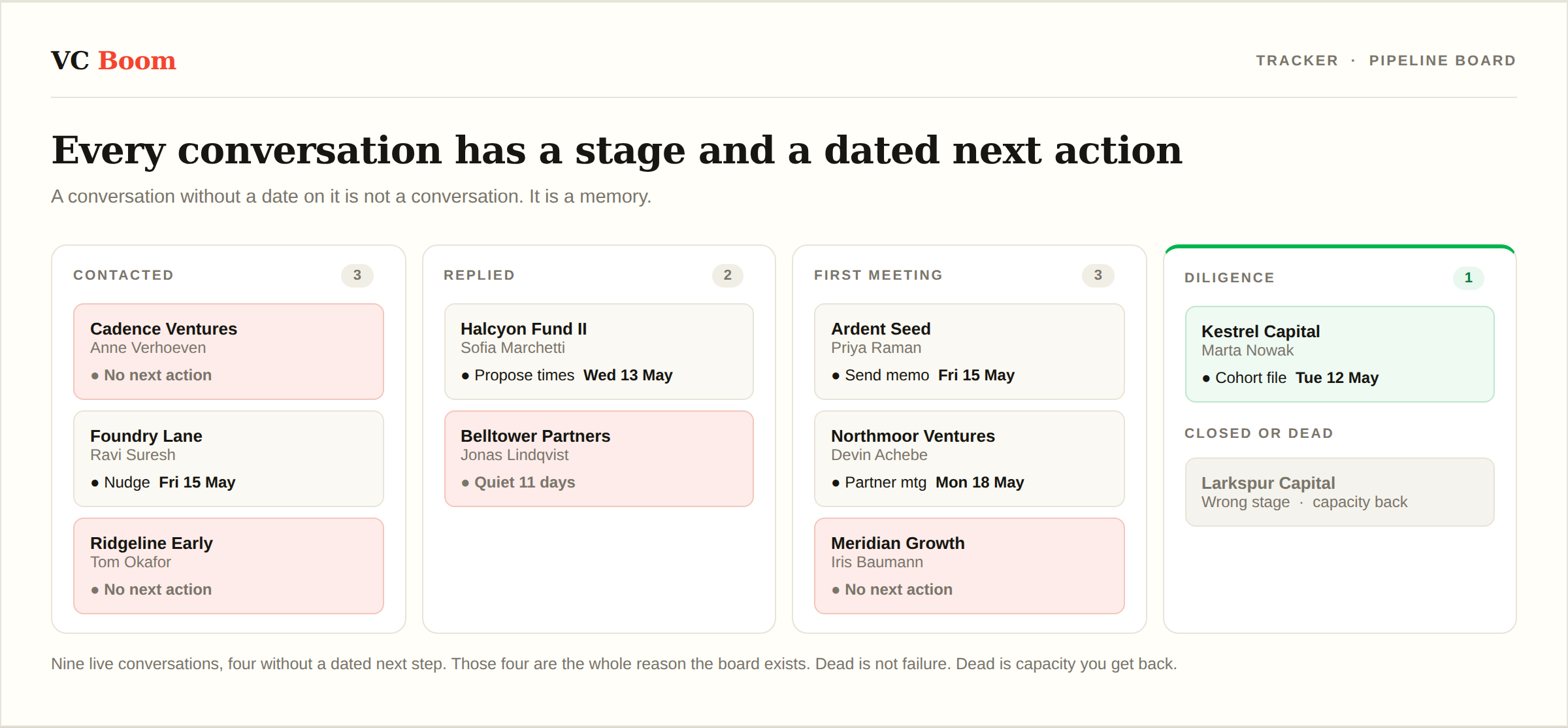
Every card should carry a note on what happens next and when. The ones that do not are the only cards that matter on any given morning.
The stages a fundraise actually has
Here are the stages Tracker uses. Each one has an honest exit criterion, which means the thing that has to be true before you move the card, not the thing you hope is true.
To contact. You have the fund on the list and nothing else. Exit: the first email is sent, from an address you control, to a named human.
Contacted. Sent, not opened, or opened without a reply. Exit: a reply. Not a bounce. Not an auto responder.
Replied. Someone typed something. Exit: a meeting is on a calendar with a time on it. "Happy to chat sometime" is still Replied.
Meeting. A call is booked or has happened, first meeting through diligence. Exit: an explicit next step, named and dated, or a term sheet. If they end a call with "let us stay in touch," the card does not move forward. It moves to nudge.
Committed. Money in or soft-circled. This is the stage you are raising toward.
Passed. Passed, ghosted, or not a fit. Not a failure. Passed is capacity you get back.
The stages are honest when the exit criteria are boring. If you have to squint at a card to justify its stage, it belongs one stage lower.
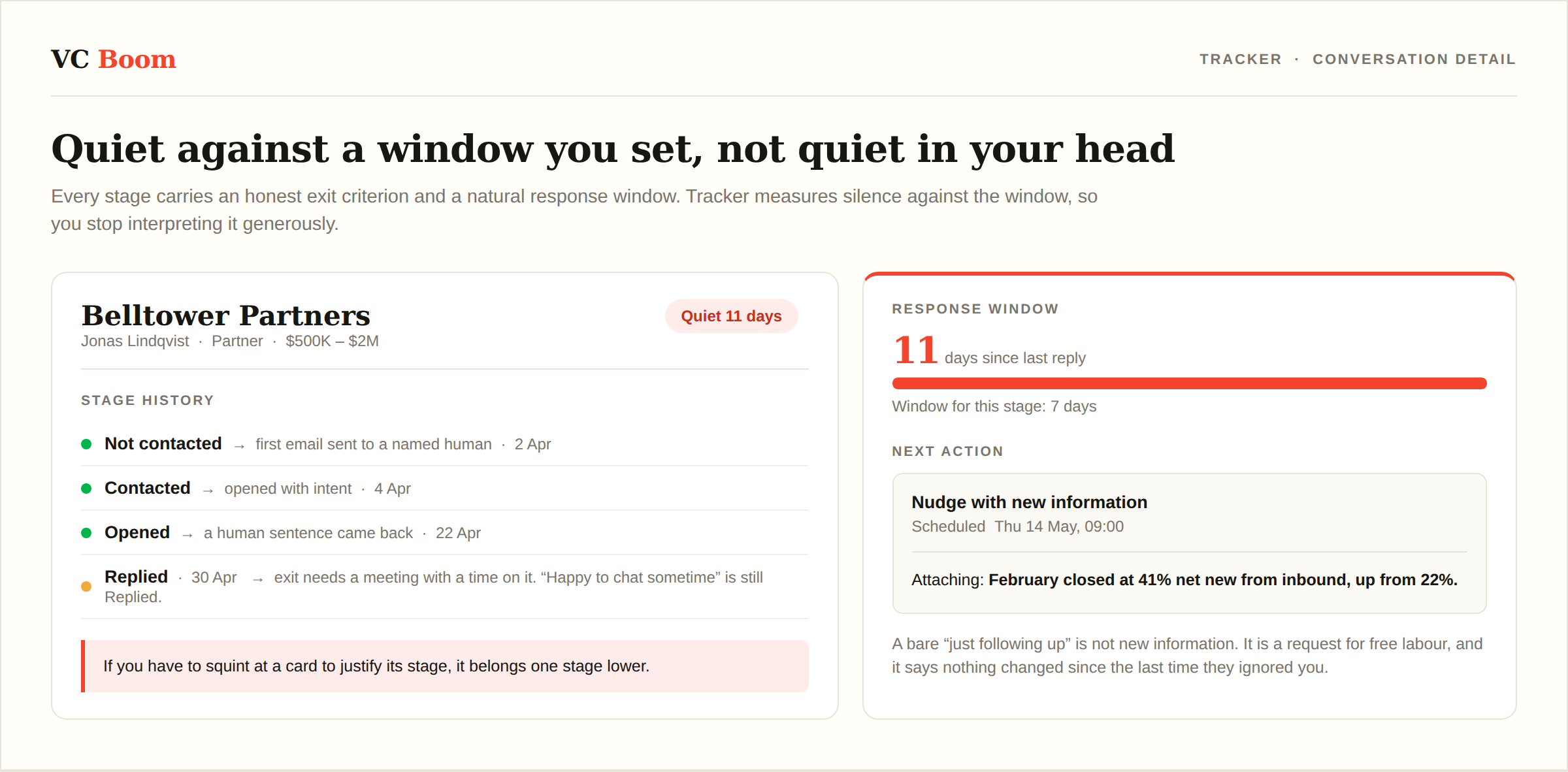
One conversation, opened up. Stage history with exit criteria, the response window, and the nudge already scheduled with something new attached to it.
Most rounds are lost to silence, not rejection
Nobody sends you an email saying they have decided not to decide.
They go quiet. You interpret the quiet generously, because that is what founders do at week six with payroll on the calendar. Three weeks later you check in, and by then the conversation is cold enough that restarting it costs more than starting a new one would have.
A fund that has not replied in eleven days is not thinking about you.
That is not a criticism of them. They have forty other things in flight and your thread is below the fold. The fix is not patience and it is not volume. It needs a nudge with new information attached.
A bare "just following up" is not new information. It is a request for free labour, and it tells the reader that nothing has changed at your company since the last time they ignored you.
Tracker keeps the last-contact date and your notes on every card, so the eleven day list is a scan, not something you hold in your head. Then you decide what new information you are attaching. We go deeper on timing in the follow-up cadence guide.
What counts as a legitimate nudge
New information means something that was not true when you last wrote. Five that work:
A number moved. Revenue, retention, pipeline, a cohort that held. One line, one figure, the delta stated plainly. "We closed February at 41% net new from inbound, up from 22%."
A person joined. A hire with a name investors recognise, or an advisor who has done the thing you are trying to do. Signal about the team compounds faster than signal about the product.
A customer said something on the record. A logo, a signed pilot, an expansion, a quote you are allowed to use. Contract value beats compliments.
The round changed shape. A lead is circling, an allocation shrank, you moved from a note to priced. This is legitimate exactly once and only when true. Manufactured urgency is detectable and it is expensive.
A proof point they asked for now exists. If they said "come back when you have enterprise retention data," come back with enterprise retention data and say so in the first sentence. This is the strongest nudge there is, and almost nobody sends it.
What does not count: a press mention nobody read, a product update with no user attached, a conference you attended, or the fact that two weeks have passed.
If a nudge has nothing to attach, the honest move is to move the card to dead and get the slot back. There is a full sequence for that in the rejection recovery playbook.
The Monday review
Review the pipeline every Monday. Anything with no next action gets one or gets closed.
Thirty minutes, same slot, before anything else. You are not reading emails. You are looking at cards with no dates on them and making a decision on each.
Target: zero conversations older than 14 days without a scheduled next step.
Zero is achievable because closing a card counts. Most founders resist this. Marking a fund dead feels like losing something, so nine dead conversations sit in the pipeline making the round look healthier than it is. That is the number that gets you to the end of a quarter believing you were close.
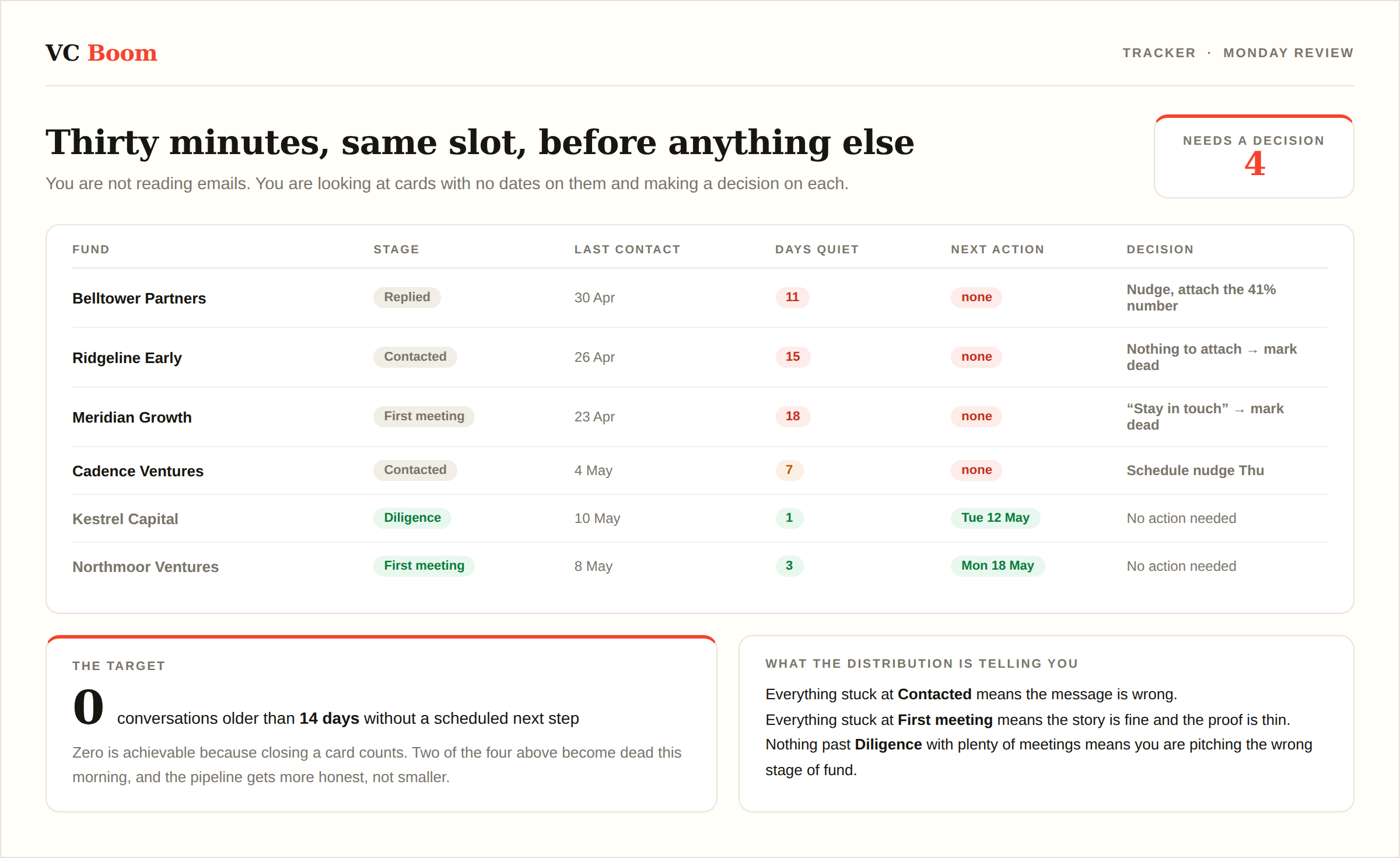
The Monday review. Six rows, four decisions, twenty minutes. Sort the board by last contact and work top down. The target is zero conversations older than fourteen days without a note on them.
A clean pipeline is usually a smaller pipeline. It is also the only one you can act on. Pair the Monday review with a monthly investor update and half your nudges write themselves, because the update is the new information.
What the pipeline is really telling you
Stage distribution is diagnostic.
Everything stuck at Contacted means the message is wrong. Everything stuck at Meeting means the story is fine but the proof is thin. Nothing past Meeting despite plenty of them means you are pitching the wrong stage of fund.
That read only works if the stages are honest, which is why the exit criteria matter more than the board looks like it should. Timing pressure changes the read too, and the nine month runway rule is worth holding next to this.
Across 1,820 decks scored and 1,300+ tracked sends, the founders who close are rarely the ones with the biggest lists. They are the ones whose Monday takes twenty minutes because there is nothing sitting there without a date.
1,264 founders and $133M+ raised later, the pattern has not changed.
You can run this on a spreadsheet if you are disciplined, and most people are not, which is why Tracker on vcboom.com does the counting for you and puts the eleven day list in front of you before you have to remember it exists.
Give every conversation a stage. Give every stage a date. Close what has no next step.