Solo founder fundraising in 2026: what investors still ask, and how to answer
The earlier version of this guide had a confident title: "why going solo is no longer a red flag". We liked the story. Then we went looking for data to support it, and the best data we found said something more complicated.
So we changed the title. Here is what we found, and what it means if you are raising on your own.
What the numbers say
Carta, the cap table platform, published its Founder Ownership Report 2025 using data from more than 45,000 startups. Two numbers from it matter here:
- 35% of new startups on Carta in 2024 had a single founder, up from 17% in 2017. Going solo is far more common than it was.
- Of the startups on Carta founded in 2024 that had raised capital, about 17% had a solo founder.
Put those side by side. Solo founders made up about a third of new companies, but only about a sixth of the ones that had raised money. That is a gap. It does not prove investors are biased against solo founders: solo companies may also be more likely to bootstrap, or to raise later. But it is not the picture of a stigma that has gone away.
The honest summary: solo founding has become normal. Raising venture money as a solo founder is still harder, on average, than raising as a team.
We do not have our own data on this. VC Boom does not record whether a founder is solo, and we do not track who closes a round. What we do score is the team dimension of every deck.
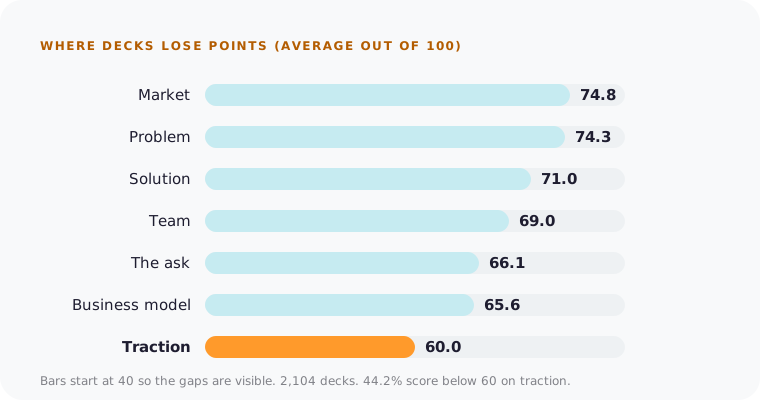
Across 2,104 decks, team averages 69.0 out of 100, fourth of seven dimensions. Traction is the weakest at 60.0.
Team is not where most decks lose the most points. Traction is. That matters for solo founders, and we will come back to it.
The questions you will get
Investors who back solo founders still ask about the same risks. Expect some version of these, and have a real answer ready, not a defensive one.
"Who else is building this with you?"
What they are really asking: can you get other good people to commit to this? A co-founder is one proof of that. It is not the only one.
Good answers point to people who have chosen to work with you:
- An early engineer, designer or operator, even part-time, even on contract.
- Advisors who give real hours, not names on a slide.
- Customers or design partners who spend time shaping the product.
If the honest answer today is "nobody yet", say so, and say who you will hire first with the money and why.
"What happens if you get sick or burn out?"
What they are asking: is all the knowledge in one head? Show that it is not. Documented processes, a contractor who could keep the lights on, a product that does not need you awake to run. You do not need a perfect answer. You need evidence you have thought about it.
"Why no co-founder?"
Answer it plainly. "I looked for one for six months, met two good people, and neither was the right fit, so I kept going" is a fine answer. So is "I can build and sell this stage myself, and my first hire covers the gap". What does not work is pretending the question is unfair.
"Can you build it?"
This one has changed the most. Tools like Claude, Cursor and v0 let one person ship far more than a few years ago. If you are non-technical and have shipped a working product, show it. A live product with users answers "can you build it?" better than any slide.
Where solo decks can make up ground
Here is where our data is useful. Across 2,104 decks, team is not the weak spot. Traction is, at 60.0 out of 100 on average, with 44.2% of decks scoring below 60 on it.
For a solo founder, that is the opening. If an investor has a reservation about the team, the strongest counterweight is evidence that the business works: paying customers, retention, a waitlist that converts, letters of intent with names on them. Your team slide can only say so much. Your traction slide can say a lot.
Three things to put on the deck:
- Your traction, early and plainly. Even small numbers, if they are real and moving.
- Your bench. A team slide that lists the contractors, advisors and first hire plan, with what each person actually does.
- Your speed. Solo founders can move fast. Show it with dates: shipped this in March, first customer in April, second in May.
What a strong solo team slide looks like
Here is a hypothetical example for a solo founder building scheduling software for clinics:
Maya Chen, founder. Ran operations at a 40-clinic group for six years. Built the first version herself; 12 clinics live. Contract engineer, 20 hours a week since March. Owns the integrations. Two advisors, monthly calls. A former clinic-group COO and a health software CTO. First hire with this round: a full-time engineer to own the platform.
Maya and her clinics are made up. The shape is the point: every line says what the person actually does, and the last line answers the question before it is asked.
If you do have a co-founder
This guide is for solo founders, but the earlier version made a claim worth correcting too: it implied a co-founder can be a liability. Teams are still the more common route to venture money, by the Carta numbers above. What investors look for in a team is evidence the relationship will hold: a history of working together, a clear split of decisions, vesting on everyone, and one person who owns the fundraise.
Should you go find a co-founder to raise?
Not just to raise. A co-founder added to look fundable, someone you met recently and have never shipped with, is a risk investors will spot in the first meeting.
The question to ask is narrower: is there something you cannot do, that you need done in the next six months, that you cannot hire for? If yes, and you know someone you have worked with who fits, have the conversation. If not, stay solo and make the deck carry the proof.
What to do this week
- Write your answer to "why no co-founder?" in two sentences. Say it out loud until it sounds calm.
- List everyone who has chosen to work with you: contractors, advisors, design partners. Put the real ones on the team slide.
- Name your first hire and what they will own.
- Move your traction earlier in the deck if it is buried. It is your strongest counterweight.
- Score your deck and look at the team and traction scores side by side.
- Build a short list of investors who have backed solo founders before. Their portfolio pages will tell you. Our guide on building your first investor list covers the rest, and our cold email guide covers what to send them.
See where your deck stands
VC Boom scores your deck across seven dimensions, including team and traction, and shows you which one to fix first. It also ranks investors who fit your stage, sector and check size, from the 47,874 we track.
Score your deck for free and see how your team slide reads to someone who has never met you.