50 investor research prompts for Claude, in five steps
Open Claude, type "which funds invest in climate startups", and you get a tidy list. The famous names. The same famous names every other climate founder got when they typed the same sentence this morning.
Nothing on that list is wrong, exactly. It is just not research. "This fund invests in climate" tells you nothing about whether they will invest in you.
Research sounds like this instead: they have backed three companies at your stage in the last two years, they write cheques in the range you are raising, they have not backed a direct competitor, and one partner led their most relevant investment, so that partner is who you write to.
That second sentence takes work. Most of the work is reading, and AI is good at reading if you ask it the right questions and make it show its sources. That is what the 50 prompts below are for.
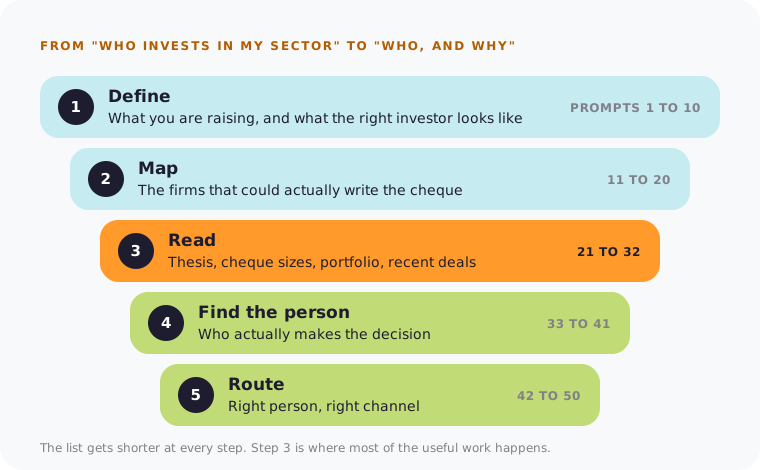
Five steps. The list gets shorter at each one, and step 3 is where it gets good.
Before you start: two blocks to paste once
Every prompt below works in Claude or ChatGPT with web search switched on. Without web search, the model answers from memory, and memory is where invented deals and outdated team pages come from.
Paste these two blocks at the top of a new conversation, then run the prompts in order. If a conversation gets long, start a fresh one and paste them again.
Block A: ground rules. This is what keeps the research honest.
Ground rules for everything in this conversation:
- Search the web. Do not answer from memory alone.
- Give a source link and a date for every fact about a firm,
  a person or a deal.
- If you cannot find a source, write "not found". Do not guess.
- Label anything you infer as "inference", separate from facts.
- Flag anything older than [12 months] as possibly out of date.
- Never invent or guess an email address, a name, a job title,
  a deal or a cheque size.
- If two sources disagree, show both.
Block B: your company card. Fill it in once. Every prompt refers back to it.
My company:
- What we do, in one sentence: [sentence]
- Sector and sub-sector: [e.g. software for cold-chain logistics]
- Stage, honestly: [pre-seed / seed / Series A]
- Raising: [amount, currency], as [SAFE / priced round]
- Proof an investor can check: [revenue, pilots, approvals, patents]
- Based in: [city, country]. Selling in: [countries]
- Comparable companies ("we are like X, for Y"): [names]
- Direct competitors: [names]
A word on the verification lines. AI research tools are confident by default. They will happily tell you a partner "focuses on B2B SaaS" because the firm did once, years ago. The ground rules turn that confidence into something you can check. When you see "not found", that is the prompt working, not failing.
Step 1: Define what you are raising and who the right investor is
Most bad investor lists start here, before any search. If you cannot describe the right investor in a paragraph, no search will find them.
1. Turn the deck into an investor brief
Use it first, with your deck attached.
Read the attached deck. Write a one-page brief an investor could
read in two minutes: what we do, for whom, the proof, the round.
Then list every claim in the deck that an investor could not check,
and tell me which ones need proof before I send anything.
2. Shape the round
Use it when you know the total amount but not how the round fills up.
We are raising [amount] at [stage]. Show two or three ways this round
could be built (one lead plus angels, two co-leads, a party round).
For each, say what size of cheque the lead and the others would
write, and the trade-offs. Do not quote market statistics unless
you can cite them.
3. Write the ideal investor profile
Use it to decide who you are looking for before you look.
Using my company card, write the profile of the investor who should
lead this round: fund type (VC, corporate, angel, family office),
stage, cheque range, sector focus, geography, and what they would
need to believe about us. Then describe an investor who looks right
on paper but is wrong for us, and explain why.
4. Turn the profile into filters
Use it to get rules you can apply to any list.
Turn the profile above into filters I can apply to a list of
investors:
1. Hard filters (must match, or the investor is out)
2. Soft filters (better if they match)
3. Deal-breakers (for example, backed a direct competitor)
Keep each filter checkable from public information.
5. Find companies that look like you
Use it to find the investors who already bought your story once.
Find companies that look like ours: same customer, same business
model, or same technology. Only include companies that raised a round
at [stage] in the [last two years]. For each: what they do, the
round, who led it, and a source link. Mark anything you could not
verify.
6. Map your competitors' backers
Use it to know who is probably conflicted before you email them.
For each direct and adjacent competitor in my company card, list who
has invested in them, with sources. Put investors in direct
competitors on a separate "probably conflicted" list. Investors in
adjacent companies go on a "worth checking" list, with one line on
why they might still fit.
7. Learn how investors would describe you
Use it to get search terms that match how funds write about themselves.
How would a venture investor describe a company like ours on their
thesis page or in a blog post? Give me a list of search phrases they
might use, from broad to narrow. Include the jargon of the sector,
not just our own words.
8. Check your real stage
Use it when you are not sure you are "seed" or still "pre-seed".
Based on the deck and my company card, which stage do our metrics
actually match, whatever we call the round? Be blunt. If we look
earlier than we claim, say so, and tell me how that changes which
investors I should approach.
9. Choose your geographies
Use it before you decide to pitch outside your home market.
Which investor geographies make sense for us, given where we are
based, where we sell, and where comparable companies raised? Point
out any practical reasons a foreign investor might hesitate, and
tell me which points I should confirm with a lawyer.
10. Run a pre-mortem
Use it to find the investors your weaknesses do not scare.
Act as a partner at a [stage] fund in [sector] who is about to pass
on us. Write the most likely reasons, in their words. Then tell me
what kind of investor would not care about those reasons, and why.
Step 2: Map the firms that could actually write the cheque
Now you search. The goal of this step is a long list with evidence, not a list of names. Every firm should arrive with a reason it is there.
11. Pull every investor from your comparables
Use it right after prompt 5. Comparables are usually your best source of names.
For each comparable company from prompt 5, find every investor in
each of their rounds. Make a table: investor, type (VC, angel,
corporate, family office), which comparable, which round, year,
source link. Merge duplicates. Put investors who appear more than
once at the top.
12. Search by thesis, in their words
Use it with the phrases from prompt 7.
Search for investment firms whose own website or published thesis
uses phrases like [phrases from prompt 7] and invests at [stage].
Only include a firm if you can quote the line from their own site
and link to it.
13. Find funds with fresh money
Use it to find firms that are likely to be writing new cheques.
Find venture firms that announced a new fund, or filed for one, in
the [last 12 months], with a focus on [sector] or [stage]. Cite the
announcement or filing for each. Note the fund name and date.
14. Build the regional map
Use it once per region you chose in prompt 9.
List investors based in [country or region] that have made at least
one investment in [sector] at [stage] in the [last two years]. One
row per firm, with that investment named as proof and a link.
15. Find the angels who have done it
Use it to add operators and angels who understand your market.
Who are the active angel investors and angel syndicates in [sector]
in [region]? Prefer people who founded or ran a company in our space.
For each, link to evidence of at least one actual investment. A
profile that just says "angel investor" does not count.
16. Check corporate venture arms
Use it when your customers are large companies.
Which companies in [our customers' industry] run a venture arm or
make strategic startup investments at [stage]? For each, list what
they have backed, with sources, and say whether those deals look
strategic (a customer or partner) or purely financial.
17. Find family offices that invest directly
Use it when a family office could join or lead the round (our family office playbook goes further).
Find family offices that have made direct investments in [sector]
startups at [stage]. Cite the deal for each. Say whether it looks
like a single-family or multi-family office, and whether it invests
directly or only through funds, if a source says so.
18. Go one step out: co-investors
Use it to find the firms that sit next to your best matches.
For these firms [paste your strongest matches], who do they
co-invest with? List co-investors that appear in at least two of
their deals, with the deals as proof. Mark any that also invest at
[stage] in [sector].
19. Clean the long list
Use it when your list has grown past what you can read.
Here is my long list: [paste]. Remove duplicates and merge firms
listed under different names. Apply the hard filters from prompt 4
and drop anyone who fails one. Show me everyone you dropped and the
reason, so I can overrule you.
20. Sort into tiers
Use it to decide who gets read closely in step 3.
Sort the remaining list into three tiers:
A: fits on stage, sector and cheque size, with a cited deal
B: fits on two of the three
C: one fit, or unclear
One line of reasoning per firm. Nobody goes into tier A without a
cited deal.
Step 3: Read their thesis, cheque sizes, portfolio and recent deals
This is the step most founders skip, and it is the one that changes who you write to. A website says what a fund would like to be known for. The deals say what it actually does.
Run these on your tier A and B firms, one firm at a time. It is slower than a batch. It is also where you find out that a "climate fund" has not done a seed deal in years, or that the perfect-looking firm backed your closest competitor last spring.
21. Read the thesis in their own words
Use it as the first read on any firm.
Read [firm]'s website, thesis page and partners' posts. Summarise
their thesis in their own words, with quotes and links. Then tell me
in one line whether a company like ours fits, and where the fit is
weakest.
22. Compare what they say with what they do
Use it on every firm whose thesis sounds like a perfect match, because those are the ones to doubt.
Compare what [firm] says it invests in with what it has actually
invested in over the [last two years]. List the deals, with stage,
sector and a source for each. Where do the words and the deals
disagree?
23. Count the deals at your stage
Use it to check stage fit with evidence, not labels.
Of [firm]'s investments in the [last two years], which were at
[stage]? List them with sources. If their "seed" deals look like
larger rounds than ours, say so.
24. Find their real cheque size
Use it before you count a firm as a possible lead, and expect some "not found" answers.
What size of cheque does [firm] write at [stage]? Use only the
firm's own statements, fund documents, or reported rounds where
their share is stated. Give a range with sources, and label which
numbers are inferred. If nothing is public, say "not found".
25. Lead or follow
Use it to split your list into possible leads and followers (you need at least one lead).
In [firm]'s deals at [stage], did they lead, co-lead or follow?
Cite each. Based on that, are they likely to lead a round like ours,
or only join one that someone else leads?
26. Check for portfolio conflicts
Use it before you send anything: a conflicted firm rarely tells you, it just does not answer.
List [firm]'s current portfolio companies. Flag any that compete
with us directly, or that would likely see us as a competitor soon.
For each flag, quote what that company does from its own website.
27. Find their most relevant deal, and who led it
Use it to find the person, not just the firm. It is often the most useful answer in the stack.
Which of [firm]'s investments is closest to us: same customer, same
model or same technology? Who at the firm led that deal or sits on
that company's board? Cite the announcement, the partner's own post
or the board listing.
28. Check where they are in their fund
Use it on firms that look perfect but have gone quiet.
When did [firm] last raise a fund, and how large was it? Cite the
filing or announcement. If the latest fund is several years old,
flag that they may be keeping money back for existing companies,
and label that as inference.
29. Check recent activity
Use it to avoid writing to a fund that has stopped writing new cheques.
List [firm]'s most recent announced investments, with dates and
links, going back [12 months]. Are they still actively investing in
[sector]? If the last announced deal is old, say so plainly.
30. Write the fit sentence
Use it as the exit test for step 3: a paragraph full of "unverified" means the firm is not ready to contact.
Using only facts from your research above, fill in this paragraph:
"[Firm] has backed [number] companies at our stage in [sector]:
[names]. They write cheques of [range] ([source]). They have not
backed a direct competitor (checked against [list]). [Partner] led
[most relevant deal]."
Where a fact is missing, write "unverified" instead of a number.
Do not soften or round anything.
31. Read a batch into one table
Use it once single-firm reads have taught you what good looks like, then spot-check the rows.
For each firm in [list], fill one row:
- Thesis fit (yes / partial / no, with a short quote)
- Deals at our stage in the [last two years] (names)
- Cheque range (with source, or "not found")
- Leads rounds? (yes / no / unclear)
- Conflict (company name, or "none found")
- Most relevant deal, and the partner who led it
- Latest fund (year)
- Last announced deal (date)
"Not found" is an acceptable answer in every column.
32. Argue against the firm
Use it on your favourite firms, the ones you are least objective about.
Argue against putting [firm] on my list. What would make them pass
on us? Then score the fit from one to five, and justify the score
with the evidence above, not with general impressions.
Step 4: Find the person who actually makes the decision
A firm does not reply to emails. A person does. At most funds, some people can champion a deal to the investment committee and others mostly source and screen. Both are useful. You want to know which is which.
33. Map the team
Use it on every tier A firm.
List the investment team at [firm] from their own team page: name,
title, focus areas, location, link. Separate investing partners from
platform, operations and investor relations staff. Flag anyone whose
page looks out of date.
34. Work out who can say yes
Use it when the team page does not make it obvious.
At [firm], who can bring a deal like ours to the investment
committee or approve a cheque at our stage? Use titles, the team
page, and who is named as leading recent deals. Explain your
reasoning and label it as inference.
35. Read one partner's track record
Use it on the partner from prompt 27.
For [partner] at [firm], list the deals they personally led or sit
on the board of, with sources. What do those companies have in
common: stage, customer, model, geography?
36. Read what they say in public
Use it to find a real reason to write to them.
Find what [partner] has written or said in public in the [last 12
months]: posts, podcasts, talks, newsletters. Summarise their views
on [our sector or problem], with links and dates. Quote them. Do not
paraphrase them into saying something they did not say.
37. Partner or associate
Use it when a firm has a sector specialist below partner level.
Is there a principal or associate at [firm] who covers [sector] and
sources deals? Based on the firm's own description of these roles,
when would it make more sense to contact them first instead of the
partner?
38. Check for recent moves
Use it on every name before you write, because team pages lag.
Has [person] changed firm, title or focus in the [last 12 months]?
Check the firm's site, their public profiles and recent press. If
the sources disagree, show all of them with dates.
39. Find the decision maker at a family office
Use it for family offices, which rarely publish a team page.
For [family office], who handles direct startup investments: a
principal, a family member, a chief investment officer, an
investment director? Is it a single-family or a multi-family office?
Cite sources. If the office does not publish this, say so instead
of guessing.
40. Find real common ground
Use it before any intro request or cold message.
Here is my background: [paste a short bio]. Compare it with
[person]'s public profile. List genuine overlaps only: past
employers, schools, cities, companies we both know, people we both
publicly know. Cite each one. No stretches.
41. Write the "why them" line
Use it as the exit test for step 4.
Write one sentence explaining why [person], specifically, should see
this deal, using only facts from the research above. If you cannot
write it without stretching, tell me they are the wrong person.
Step 5: Route the outreach to the right person and channel
The same message lands differently through a mutual contact, a pitch form, an email or a LinkedIn note. This step picks the route before you write a word.
42. Find warm paths
Use it with a list of people you know.
Here are people I know: [paste names and companies]. For [person]
at [firm], which of my contacts could plausibly know them: worked
together, co-invested, sit on a board together, or a founder they
backed? Cite the public evidence for each link and rank them by
strength. Do not assume a connection without evidence.
43. Ask a portfolio founder
Use it when you have no mutual contact.
Which founders in [firm]'s portfolio could I credibly ask for an
introduction, given what we do? Prefer companies that sell to the
same customer without competing with us. For each, write one reason
they might say yes.
44. Check how the firm wants to be pitched
Use it before choosing between email, a form and an intro.
How does [firm] say it wants to receive pitches: a form, a general
inbox, intros only, or direct to partners? Quote the firm's own
instructions and link the page. If [person] has said in public how
they prefer to be pitched, include it with the source.
45. Find the contact route, without guessing emails
Use it instead of asking an AI for someone's email address.
Do not guess or construct [person]'s email address. Tell me:
1. Does [firm] publish a contact address or a pitch form? Link it.
2. Does [person] list a public contact method anywhere? Link it.
If neither exists, write "not found" and suggest the best public
channel instead.
Whatever address you end up with, run it through an email verification tool before you send. In our own data, verified addresses got replies to 2.7% of emails and catch-all addresses to 1.7%.
46. Write the forwardable intro
Use it when a contact agrees to introduce you.
Write a short intro blurb that [mutual contact] can forward to
[person] as it is. Include what we do, one checkable proof point,
the round, and the "why them" line from prompt 41. No adjectives an
investor could not check. Keep it short enough to read on a phone.
47. Write the cold email for this one person
Use it when there is no warm path (what 1,962 real sends taught us about the shape).
Write a cold email to [person] at [firm]. First line: why them,
using the deal or post from my research. Then what we do, one proof
point an investor can check, the round, and a small ask (a short
call). Do not invent traction, quotes or connections. After the
email, list every factual claim in it so I can check each one.
48. Write the LinkedIn note
Use it when LinkedIn is the better first touch.
Write a LinkedIn connection note to [person] that refers to
[their post or deal]. No pitch in the note, and keep it inside
LinkedIn's character limit for connection notes. Then write a short
follow-up message to send only if they accept.
49. Plan the waves
Use it once you have tiers, people and routes.
Here is my list with tiers, people and channels: [paste]. Plan the
order: who to contact first, who to hold until we have a lead or
some momentum, and who to reach through an intro rather than
directly. Keep each wave small enough that I can personalise every
message.
50. Learn from what came back
Use it after each wave.
Here are the results so far: [paste who replied, who passed and
why, who stayed silent]. Compare the replies with the silences on
stage, cheque size, sector, person and channel. Suggest changes to
my investor profile from prompt 3. If the number of replies is small,
say so, and do not present a pattern as a rule.
What these prompts will not do
They will not make a weak round strong. Research tells you who might fit. It does not change what you are offering them.
They will also get things wrong. Team pages are stale, cheque sizes are rarely public, and models still misread a press release now and then. The ground rules help, and the sources let you check, but someone has to check. That someone is you, especially for the firms in tier A.
And they take time. Reading one firm properly through step 3 is real work. That is the point: the founders in our data who sent fewer emails got a higher reply rate. Those who sent 25 or fewer got replies to 9.3% of them; those who sent more than 100 got 1.2%. That gap is associated with list size. It does not prove that sending less causes replies. Founders with a stronger company or a more obvious fit may simply need fewer emails. But it is a good reason to spend the time on reading rather than on volume.
If you want a head start on steps 2 and 3
VC Boom does the first pass of mapping and reading for you. We track 47,874 investor records across 58 countries, and we check SEC filings and firm portfolio pages, then show the date we checked. 1,377 investors in our database raised a new fund in the last 12 months, according to SEC Form D filings we matched them to.
- Find the 25 investors who fit your raise, ranked against your stage, sector and cheque size.
- Upload your deck for a free score across seven dimensions and a ranked list to read through with the prompts above.
- Browse our free investor and family office lists if you want a starting long list today.
Then run steps 3 to 5 on the top of that list. The prompts are yours to keep either way.