Cold email to investors: what 1,962 real sends taught us
We opened the spreadsheet expecting to write a confident guide. It took three passes before the numbers stopped lying to us.
Since April 16, 2026, founders on VC Boom have drafted 4,574 emails to investors. They sent 1,962 of them. Fifty got a reply.
That is 2.5%.
If you have read that cold email to investors "gets 10 to 15% replies", that number did not come from our data, and we stopped repeating it. This guide is what actually happened, including the part where we fooled ourselves.
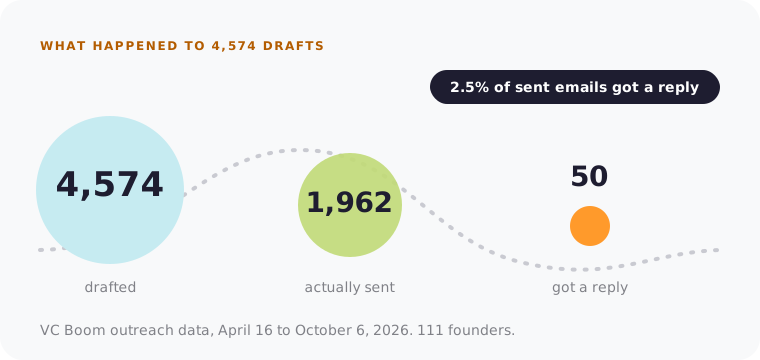
The real funnel. Most drafts never leave the founder's outbox, which is a story for another day.
The finding we almost published
Our first cut said: send on Wednesday. Wednesday emails got 3.5% replies, nearly double Monday and Tuesday. It made a tidy headline.
Then we looked at who was sending. One founder had sent 834 of the 1,962 emails, almost half the dataset, and they happened to send a lot on Wednesdays. With that founder set aside, Tuesday and Wednesday came out at 2.9% and 3.1%. The "best day" was one person's calendar.
We are telling you this because the internet is full of cold email stats built on exactly this mistake. If someone shows you a magic send time, ask how many people it came from.
What actually held up
1. Fewer emails, more replies
This is the one that surprised us. We grouped founders by how many emails they sent in total.
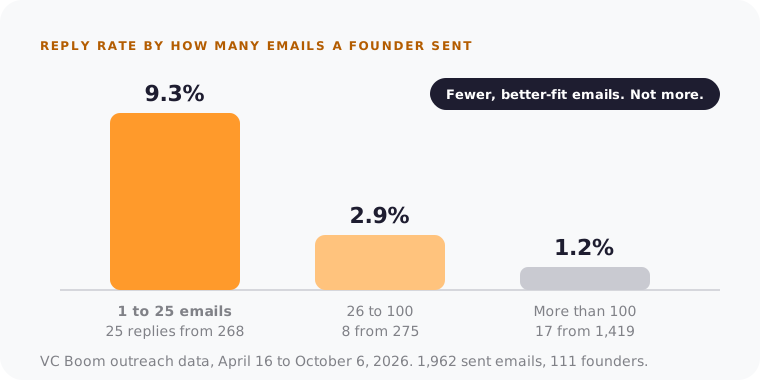
Founders who sent 25 emails or fewer got replies to 9.3% of them. Founders who sent more than 100 got 1.2%.
Founders who sent 1 to 25 emails: 25 replies from 268 emails, 9.3%. Founders who sent more than 100: 17 replies from 1,419, 1.2%.
Be careful with what this means. It does not prove that sending less causes more replies. Founders with a strong company and an obvious fit may simply need to send fewer emails. But it does kill the idea that cold outreach is a volume game where you blast 500 investors and wait. The founders who got the best rate picked a short list and wrote to it.
2. Real addresses matter
Every investor email in our database carries a verification status. Verified addresses got 2.7% replies. Catch-all addresses, domains that accept any email so you cannot be sure a person is behind it, got 1.7%. The gap holds with the big sender removed (3.0% vs 2.0%).
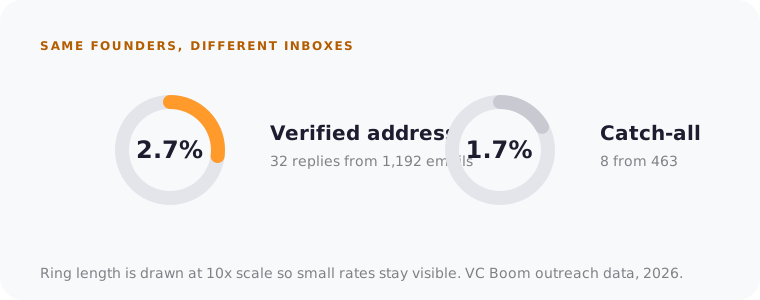
Same founders, same kind of drafts, different inboxes.
If you build your list by hand, verify before you send. A bounce does not just waste a send. It quietly hurts the next email from your domain.
3. The same email can get a yes and a silence
The most humbling thing in the data: one industrial automation founder in Europe sent almost word-for-word the same email to hundreds of investors. A handful replied. Most never did.
Same subject line. Same numbers. Same ask. The difference was not the copy. It was the person reading it: their thesis, their fund cycle, how full their week was.
That is the honest limit of any template. It gets you read. It does not get you funded. Fit does.
What the emails that got replies look like
We read the emails that got a reply, one by one. They are not clever. Most follow the same plain shape:
- Who you are and what the company does, in the first two lines. In plain words. "We help hospitals schedule night shifts without a spreadsheet" is the level of plainness.
- Proof, stated as facts. A granted patent. A regulatory approval. Signed revenue. Letters of intent. Paying customers named by type. 98% of the emails that got a reply contained at least one number.
- The round, in one sentence. Amount and stage. "We are raising $750K pre-seed to get our first two pilots live."
- A small ask. Nearly all of them end the same way: "Worth 20 minutes this week?" Every one of the 50 contained a question.
Here is the shape with the brackets you fill in:
Subject: [What you do] for [who it is for]
Hi [first name],
I am [name], founder of [company]. We [what you do, in words a friend would repeat].
[Your strongest proof, as facts with numbers and dates.]
We are raising [amount] [stage] to [the one thing this money unlocks]. Worth 20 minutes this week?
[Name]
Many of the silent emails look exactly like this too. The shape is necessary, not sufficient. In the emails we read, what stood out in the replies was the proof line. They leaned on things an investor can check: an approval, a patent, revenue already signed. It is a pattern from reading, not a statistic, but it matches what investors say they want.
Length mattered less than we expected. Replied emails had a median of 116 words, silent ones 124. That is a small gap on a small sample, so do not cut useful facts to hit a word count. Cut the adjectives instead.
Follow-ups, honestly
We do not have enough replies to follow-ups in our own data to put a number on them, so we will not invent one. What we can say is what a good follow-up looks like: short, sent three to five business days later, and it adds nothing that is not true.
That last point is personal for us. Earlier this year, our own follow-up drafts sometimes invented progress ("we just signed a new partner") to make a nudge sound fresh. We caught it, fixed it, and now follow-ups only restate what you already wrote. An investor who later finds out a follow-up was embellished does not reply to the next one.
A follow-up that works sounds like this:
Hi [first name], following up on my note below in case it got buried. Worth 20 minutes?
That is the whole thing.
A plan for the next three weeks
- Pick 25 investors, not 250. Matched on stage, check size and sector. If you cannot write a real reason why a fund fits, it does not go on the list.
- Verify every address. Drop what you cannot verify.
- Lead with checkable proof. Approvals, patents, signed revenue, LOIs. Projections go in the deck.
- Send, then wait five business days. Follow up once, briefly.
- Then pick the next 25, using what the replies (and silences) taught you about fit.
- Track replies, not opens. Open tracking is unreliable now that Apple Mail and Gmail load images through proxies.
If you want help with the boring parts
VC Boom builds the short list and the first drafts. Upload your deck and you get a score across seven dimensions, a ranked list of investors who fund your stage and sector, out of the 47,874 we track, and a first draft of each email in the shape above. The draft is a starting point. The proof line is yours to sharpen.
Score your deck for free and see who comes up first.