How Long Does a Seed Round Take? A 2026 Timeline Guide
We wanted to answer this question with our own numbers. We could not.
VC Boom sees founders score decks, build investor lists and send emails. It does not see the term sheet or the wire. Founders rarely come back to tell us they closed, and when they do, it is months later. So we have no honest median for "first email to money in the bank", and we are not going to invent one.
What we do have is something more useful for the first month: a clear picture of where founders stall before the clock even starts. That turns out to be the biggest delay we can see.
The stall nobody counts
Most timeline guides start the clock at the first investor email. Our data says that is too generous. Many founders never get there.
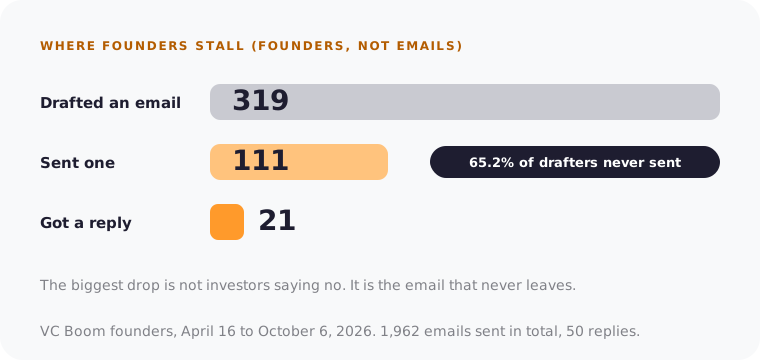
Founders on VC Boom, April 16 to October 6, 2026.
Since April 16, 2026, 319 founders drafted at least one investor email on VC Boom. 111 sent one. That means 65.2% of founders who wrote a draft never sent it.
We do not know all the reasons. Some were not ready to raise yet and were testing the tool. Some found investors another way. But some were simply stuck: polishing the deck one more time, waiting for a warm intro, rewriting the first line. Every week in that state is a week added to the round that no timeline guide will show you.
If you take one thing from this guide, take this: your round does not start when you decide to raise. It starts when the first email leaves.
A planning range, phase by phase
Since we cannot give you measured data, here is the planning range we would use ourselves. It comes from how the work breaks down, not from a dataset, so treat it as a budget, not a forecast.
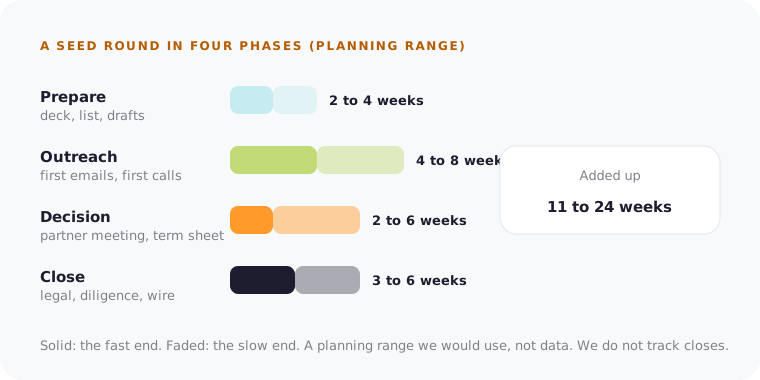
Fast end in solid, slow end faded. About 11 to 24 weeks added up.
Prepare: 2 to 4 weeks
Deck, investor list, first drafts, a simple tracker. This is the phase founders either skip or stretch forever. Skipping it costs you later. Stretching it is the stall above.
Give it a hard end date. When the date comes, you send, even if the deck is not perfect.
Outreach: 4 to 8 weeks
First emails, follow-ups, first calls. If you work in batches of about 25 investors and learn from each batch, this is where most of the calendar goes.
For a sense of what to expect: across 1,962 investor emails founders sent through VC Boom, 2.5% got a reply. Founders who sent 25 emails or fewer in total got replies to 9.3% of them. Founders who sent more than 100 got 1.2%. That is an association, not proof, because founders with a strong company may simply need fewer sends. But it argues for small, well-chosen batches over one giant send. Our guide on building your first investor list shows how.
Decision: 2 to 6 weeks
Partner meetings, a partnership meeting at funds that have one, then a term sheet if it goes well. You control less here. What you can control is how quickly you answer questions and send what they ask for.
Close: 3 to 6 weeks
Lawyers, confirmatory diligence, signatures, wire. A SAFE round can close much faster than a priced round because the documents are shorter. Our plain-language SAFE guide covers the trade-off.
Three things speed this phase up: a lawyer who has done venture deals before, a clean data room before anyone asks, and answering diligence requests within a day.
What fast rounds tend to do in month one
We cannot measure this, so read it as practice rather than proof. When founders describe a round that moved quickly, the first month usually looks like this.
They built the list before writing a word. A few dozen investors who fund their stage, check size and sector, and who are active. One signal we track: 1,377 investor records in our database were matched to SEC Form D filings for a new fund in the last 12 months. Fresh money is a good reason to move an investor up the list.
They sent in parallel. Not one investor at a time while "waiting to hear back". Silence is the default outcome of a cold email, so waiting on any single fund costs you weeks.
They tracked everything. A spreadsheet is enough: investor, date sent, reply, meeting, next step. After two batches you can see which kind of investor replies. Without it you are guessing.
They did not chase warm intros for a month first. Warm intros help when you have them. Spending four weeks trying to manufacture them before sending a single cold email is one of the most common ways a round slips. Our cold email vs warm intro guide goes into when each makes sense.
What adds months
Pitching the wrong stage. A Series A fund will take a polite meeting with a seed company and then pass. The meeting feels like progress. It is not.
Rebuilding the deck from scratch mid-process. If the deck is not landing, find the one weak part and fix that. In our scoring of 2,104 decks, traction is the weakest dimension on average: 60.0 out of 100, with 44.2% of decks scoring below 60 on it. That is usually where to look first.
Waiting. Waiting for one fund, for one intro, for one more month of metrics. Waiting is where most of the slow end of the range comes from.
If you are in month four and nothing is moving
Run this check before you send another email:
- The list. How many investors you pitched actually fund your stage and check size, and have been active recently? If it is under half, rebuild the list first.
- The deck. Score it. If one dimension is far below the others, fix that one slide and send the next batch.
- The volume and spread. Under about 40 investors contacted is probably too few to judge. Hundreds with no meetings points back to the list or the deck.
- The meetings. Meetings but no second meetings is a pitch problem, not a list problem. Our runway guide covers how much time you have to fix it.
What to do this week
- Write down your send date. Two to four weeks from today. Put it in your calendar.
- Build the first 25. Stage, check size, sector, recent activity, a named partner.
- Score your deck once. Fix the weakest dimension. Do not rebuild everything.
- Set up your tracker. Six columns is enough.
- On the send date, send. The round starts then, not before.
If you want to start the clock sooner
Upload your deck and VC Boom scores it across seven dimensions and ranks investors who fit your stage, sector and check size, from the 47,874 we track. It also drafts the first email, which is the one most founders never send.
Score your deck for free and set your send date.