What is a SAFE note? The 2026 founder plain-language guide
Picture a hypothetical founder, Ana. Over ten months she raises $1.25M on three SAFEs. An angel puts in $500K at a $5M cap. A few months later, with more traction, a small fund puts in $250K at $8M. Then $500K more at $10M. Each deal felt reasonable on the day she signed it.
A year later she raises a Series A, and her lawyer sends the pro forma cap table. Ana expected to own around 75% of the company after the round. She owns 65.5%.
Nothing went wrong. Nobody cheated her. She just never added the three SAFEs together. This guide is about how SAFEs work, so you can do that sum before you sign, not after.
Ana and her numbers are made up. The math is standard. And we are not lawyers: use this to understand the instrument, then have a lawyer look at your actual documents.
What a SAFE is
SAFE stands for Simple Agreement for Future Equity. Y Combinator published it in 2013 and switched to the post-money version in 2018. The standard documents are free on YC's website.
The idea fits in one line: an investor gives you cash now, and gets shares later, when you raise a priced round.
A SAFE is not a loan. There is no interest and no repayment date. It is not equity yet either: until it converts, the holder is not a shareholder and cannot vote. If the company never raises a priced round and fails, the money is lost, like any other early investment.
The three standard versions
YC currently publishes three versions of the post-money SAFE, plus an optional side letter:
- Valuation cap, no discount. By far the most common. The cap sets the maximum valuation at which the money converts.
- Discount, no valuation cap. The investor converts at a discount to the next round's price, often 10% to 20%.
- Uncapped MFN. No cap, no discount. MFN means "most favoured nation": if you later sign a SAFE with better terms, this investor can take those terms too.
- Pro rata side letter. Optional. Gives the investor the right to buy into a future round to keep their ownership.
You will also see older pre-money SAFEs, and custom versions that combine a cap and a discount. If a document is not one of the standard forms, read the differences line by line with a lawyer. Custom terms hide in places nobody reads twice.
How a post-money SAFE converts
This is the part worth slowing down for.
With a post-money cap, the investor's ownership at conversion is roughly:
ownership = amount invested / post-money valuation cap
So $500K on a $5M post-money cap means the investor will own about 10% of the company, measured just before the new priced round money comes in.
That is the appeal: it is predictable. The investor knows what they bought. You know what you sold.
It also means something founders miss. Each post-money SAFE takes its percentage from the existing holders, which in practice means you. SAFE holders do not dilute each other. So every SAFE you sign adds straight to the total you have sold.
Ana's three SAFEs, added up
Here is Ana's cap table with the option pool left out to keep it readable.
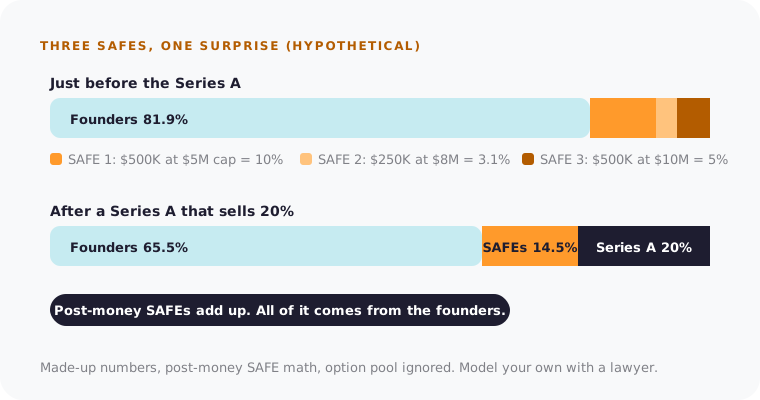
Made-up numbers, standard post-money math, option pool ignored.
- SAFE 1: $500K at $5M = 10%
- SAFE 2: $250K at $8M = 3.1%
- SAFE 3: $500K at $10M = 5%
Total sold on SAFEs: 18.1%. Ana holds 81.9% going into the Series A. Then the Series A investor buys 20% of the company, which dilutes everyone, Ana and the SAFE holders alike. Ana ends at 65.5%.
In real life the option pool usually makes this lower, because investors often ask for the pool to be topped up before their money comes in. Model it with your actual pool.
None of Ana's three SAFEs was a bad deal. The surprise came from looking at them one at a time.
Pre-money SAFEs, briefly
The original SAFE used a pre-money cap. With pre-money SAFEs, the cap is measured before the SAFE money, and multiple SAFEs dilute each other as well as you. That makes the founder's dilution harder to predict, which is one reason YC moved to post-money.
The practical rule: keep every SAFE on the same version. Mixing pre-money and post-money SAFEs on one cap table makes the conversion math painful for everyone at the next round.
When a SAFE fits, and when it does not
SAFEs tend to fit when:
- The round is small and early, and you want to close investors one by one as they commit.
- There is no lead willing to set a price.
- You want to keep legal costs and closing time low.
A priced round tends to fit better when:
- The total you are raising on SAFEs is getting large, and the stack is hard to reason about.
- A lead investor is ready to set terms.
- You are close to a priced round anyway, and adding more SAFEs now just makes the next cap table messier.
There is no magic dollar threshold. The test is whether you can still explain your ownership after the next round in one sentence.
Where this shows up in your deck
Your SAFE terms belong on the ask slide: how much, on what instrument, at what cap if you have set one, and what the money buys. In our scoring of 2,104 decks, the ask averages 66.1 out of 100, one of the lower dimensions. Vague asks are common. "Raising $1.5M on a post-money SAFE, $12M cap, 18 months of runway to reach our next milestone" is the level of clarity that helps.
A checklist before you sign
- Compare it with the standard YC form. Mark every difference and ask why it is there.
- Confirm post-money or pre-money. Match your existing SAFEs.
- Add it to your cap table model. Include every SAFE you have already signed.
- Project one realistic next round. Note your ownership after it, with the option pool.
- Read any MFN clause and work out what "better terms" would mean for you.
- Check for a pro rata side letter. Know what you are giving.
- Have a lawyer review your first SAFE, even on the standard form.
What to do this week
- Open a spreadsheet and list every SAFE you have signed or are discussing: amount, cap, version.
- Add up the percentages for post-money SAFEs. That total is what you have sold.
- Model one next round at a valuation you think is realistic, and see where you land.
- Decide your stopping point. The total you are willing to sell on SAFEs before moving to a priced round.
- Rewrite your ask slide so it states the instrument and the terms plainly.
If you are planning the round itself, our seed round timeline guide and runway guide cover when to start, and our guide on building your first investor list covers who to ask.
Check your ask before investors do
VC Boom scores your deck across seven dimensions, including the ask, and tells you which slide to fix first. It also ranks investors who fit your stage, sector and check size, from the 47,874 we track.
Score your deck for free and see how clear your ask reads.