The 9-month runway rule: when you should actually start fundraising
Picture a hypothetical founder, Tom. He has $400K in the bank and burns $100K a month. Four months of cash. He sends his first investor email on a Monday.
The round does come together, after a fashion. But by month three every conversation has an unspoken subtext: the investor knows Tom cannot walk away. Tom knows it too. He stops pushing on terms. He takes the first term sheet that arrives, from a fund he met three weeks earlier, because the alternative is missing payroll.
Tom is made up. The squeeze is real, and it does not show up in any timeline chart. It shows up in the terms you accept when you have no time left to say no.
This guide is about avoiding Tom's month three. The short version: start raising when you still have about nine months of usable runway, which for most companies means about a year of cash.
Cash runway is not the number that matters
Runway in months is your bank balance divided by your monthly burn. Everyone knows that one.
The number that matters is shorter. Call it usable runway: the time during which you can still say no to a bad offer. It ends well before the cash does, for three reasons.
- Investors can see it. They will ask about your cash. A company with three months left has no real option to walk away, and everyone at the table knows it.
- You make worse decisions under a deadline. Not because you are weak. Because "bad terms" beats "no company", and that trade gets real as the date gets close.
- Your existing investors get cautious. Asking them for a bridge from a position of weakness is a different conversation from asking with time to spare.
How much earlier does usable runway end? We do not have data to put an exact number on it. We use three months as a working assumption. It is a judgment, not a measurement, and if your business is lumpy or your burn is rising, give yourself more.
The math, with an example
Here is the rule as arithmetic:
Usable runway   = (cash / monthly burn) - 3 months
Start raising   = when usable runway is about 9 months
Why nine? Because a seed round is a multi-month process, and things go wrong. Our seed round timeline guide lays out a planning range of roughly 11 to 24 weeks from preparation to wire, before anything slips. Leads drop out. A partnership meeting gets pushed. Lawyers take longer than promised. Nine months of usable runway covers a six-month process with three months of cushion.
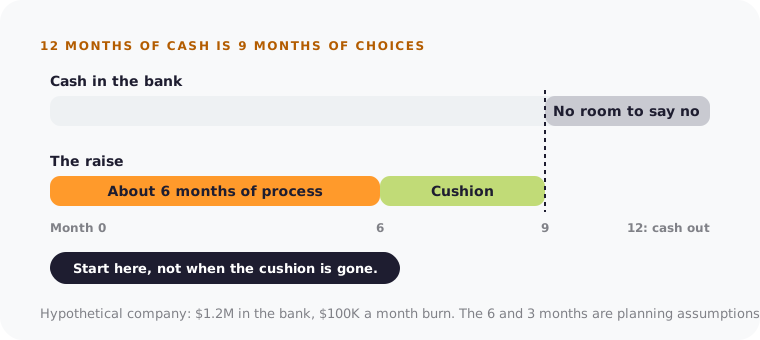
A hypothetical company with $1.2M in the bank and a $100K monthly burn. The 6 and 3 months are planning assumptions.
That hypothetical company has 12 months of cash and 9 months of usable runway. It should start now.
Now take the same company with $900K in the bank. Nine months of cash, six of usable runway. If the round takes six months, it closes on the day your room to say no runs out. That is not a plan. That is a coin toss.
Adjusting the rule
The rule is a default. A few situations move it.
- Lower burn, smaller round. A pre-seed company raising a small angel round can often start a bit later, because a slip costs less and the process is lighter.
- Higher burn, bigger round. Series A processes tend to involve more diligence and more people. Start earlier.
- Little or no traction. If you are raising on vision, expect a longer process. Start earlier.
- A committed bridge. If existing investors have agreed to extend your runway, in writing, you have more time. A verbal "we will be there for you" is not runway.
- A lead already circling. If a partner has said they want to lead and roughly at what terms, you are mid-process, not starting cold. Different situation.
Why founders start late
The honest answer is that starting is uncomfortable. The deck never feels finished. The metrics will look better next month. A warm intro might come through.
We see this in our own data. 319 founders drafted at least one investor email on VC Boom since April 16, 2026. 111 sent one. That is 65.2% of drafters who never sent a single email. Some had good reasons. But every month of "almost ready" comes straight out of usable runway.
The deck rarely needs to be perfect to start. In our scoring of 2,104 decks, the median score is 72 and only 5.3% reach 80 or higher. Most decks we see land in the 70s. The common weak spot is traction, which averages 60.0 out of 100 across all decks. If that is yours, fix the traction slide and go. Do not wait for a better quarter.
What to tell investors about your runway
You will be asked. Answer with the number, not a mood. "We have 14 months of cash at current burn, and we are raising now so we are not negotiating against a deadline" is a strong sentence. It tells the investor you planned, and it quietly tells them you can walk away.
If your runway is short, do not hide it. Investors find out in diligence anyway, and a founder who was vague about cash loses trust that is hard to win back. Say what you are doing about it: cutting burn, a bridge from existing investors, a revenue milestone that changes the picture.
The first 90 days, once you start
Days 1 to 30: build the system.
- Score your deck and fix the weakest dimension. One slide, not a rebuild.
- Build your list. About 100 investors who fund your stage, sector and check size, ranked into tiers. Our guide on building your first investor list walks through it.
- Draft your first email and your follow-ups before you send anything. Our cold email guide has the shape that worked in the replies we read.
- Set up a tracker. A spreadsheet works.
Days 31 to 60: send in batches.
- Send to your first 25. Follow up on a steady cadence.
- Ask the people who know you well for a few specific introductions. Do not wait on them before sending cold.
- Read every reply and every silence. Reorder the next batch based on what you learn.
Days 61 to 90: meetings and pressure.
- Run meetings close together so interest overlaps.
- If you have had many first meetings and no second ones, the problem is the pitch, not the list. Fix that before sending more.
What to do this week
- Calculate your usable runway. Cash divided by burn, minus three months.
- If it is under nine months, start this week. Not next month.
- If it is over nine months, put the start date in your calendar, the month your usable runway crosses nine.
- Ask your existing investors one direct question: "If the round slips, what would you do?" Get the answer before you need it.
- Draft your first investor email now, even if you will not send it for weeks. The draft is the part founders put off.
If you want the prep to take weeks, not months
VC Boom scores your deck across seven dimensions, ranks investors who fit your stage, sector and check size from the 47,874 we track, and drafts the first email for each. It does not decide when you start. That part is the rule above.
Score your deck for free and see how much prep you actually have left.