How to follow up with investors: why you should send the third email
Earlier this year we found a problem in our own product. Some of the follow-up drafts VC Boom wrote for founders were inventing progress. A nudge would say "we just signed a new partner" when the founder had signed nothing. The model was trying to give the investor a reason to look again, and it reached for a reason that was not true.
We fixed it. Follow-up drafts now only restate what the founder already wrote. But it taught us something about follow-ups that most guides skip. The pressure to sound fresh is exactly what pushes people into embellishing. And an investor who later finds out a follow-up was embellished does not reply to the next one.
So this guide is about following up well, which mostly means following up honestly, a few times, and then stopping.
What we know, and what we do not
Here is the honest state of our data. Founders on VC Boom have sent 1,962 investor emails since April 16, 2026. Fifty got a reply, 2.5%. Of the 111 founders who sent, 21 got at least one reply.
We do not yet track which replies came after the first email and which came after a follow-up. So we cannot tell you that "the third email gets 30% of replies" or any number like it. If you see that kind of stat elsewhere, ask where it came from.
What the 2.5% does tell you is that silence is the normal outcome of a single cold email. Most investors are not saying no. They are busy, or between funds, or read you on a phone and meant to come back. A follow-up gives the same person another moment to see you. That is the whole argument, and it does not need a made-up statistic.
The cadence we suggest
This is a planning default, not a measured result. It is the shape we would use ourselves.
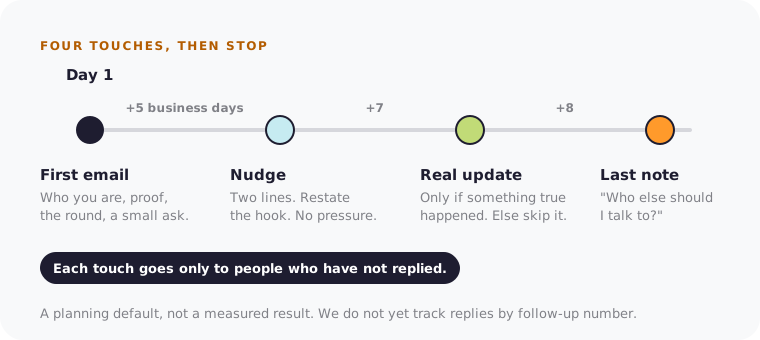
First email, a short nudge, a real update if you have one, a last note. Each goes only to people who have not replied.
- Day 1: the first email. Who you are, your strongest proof, the round, a small ask. Our cold email guide has the shape.
- About 5 business days later: the nudge. Two or three lines. Restate the hook so the email stands on its own.
- About 7 business days after that: the update. Only if something true and material happened. If nothing did, skip this one rather than inventing it.
- About 8 business days after that: the last note. Offer an easier way to help, then stop.
The gaps get longer on purpose. Short gaps read as pressure. Longer ones read as someone running an organised process, which is what investors want to see.
If your round has a real deadline, you can tighten the gaps. We would not go below three business days.
What to write at each step
Here is a full sequence for a hypothetical founder, Sam, who builds billing software for solar installers. Sam, the company and the numbers are made up.
The first email:
Subject: Billing software for solar installers, $340K ARR
Hi Elena,
I am Sam, founder of Gridbill. We replace the spreadsheets solar installers use to bill homeowners on financed systems.
We are at $340K ARR with 14 installers in Texas and Arizona, and none has churned in eight months.
We are raising a $1.8M seed to reach 60 installers. You led [similar company]'s seed, so I thought this might fit. Worth 20 minutes?
Sam
The nudge:
Subject: Re: Billing software for solar installers, $340K ARR
Hi Elena, following up in case this got buried. Gridbill: billing software for solar installers, $340K ARR, raising a $1.8M seed. Worth 20 minutes?
Sam
Notice that the nudge repeats the facts. Nobody re-reads the first email before opening the second. If the follow-up only says "following up on my note below", you are asking them to do work.
The update, only if it is real:
Hi Elena, one update since I wrote: our 15th installer went live this week, the first one in Florida. Still raising the $1.8M seed. Happy to send the deck.
Sam
If Sam had no new installer, Sam would skip this email. A follow-up that says "lots of momentum here" with nothing behind it is worse than no follow-up.
The last note:
Hi Elena, last note from me. If seed-stage climate software is not your focus right now, is there someone at the firm I should talk to instead? Either way, thanks for reading.
Sam
This one tends to work for a simple reason: forwarding an email costs an investor 20 seconds, and taking a meeting costs an hour. You are lowering the cost of helping you.
The rules we hold our own drafts to
These came out of fixing our own follow-up bug:
- Every fact in a follow-up must already be in the first email or come from the founder. No new partners, customers or metrics unless they are real.
- Same numbers every time. If you said $340K ARR in email one, do not say "nearly $400K" in email three unless it changed. Investors notice drift.
- Each email stands alone. Restate who you are and what you do in one line.
- No guilt. "I know you are busy, but..." and "just bumping this to the top of your inbox" add nothing.
- Same tone throughout. A crisp first email followed by an apologetic third one reads like a different person.
When to stop
Four touches over about five weeks is the ceiling we would set. After that, silence is an answer. It may be about timing, fund cycle or fit rather than about you, but a fifth email will not change it.
The exception is a real event. If you sign a major customer, get a term sheet from someone else, or hit a milestone that changes the deal, you can write again. That is not a follow-up. It is a new email with new information, and it can go to people who passed too.
Why a short list makes this possible
Following up four times sounds like a lot of work. It is, if your list is 400 names. That is one more reason to keep the list short.
In our data, founders who sent 25 emails or fewer in total got replies to 9.3% of them. Founders who sent more than 100 got 1.2%. That is an association, not proof: founders with stronger companies may simply need fewer sends. But it fits what we see. A short list you follow up with properly is easier to run, and it lines up with better reply rates. Our guide on building your first investor list covers how to get to the first 25.
One more thing from the data: 319 founders drafted at least one investor email on VC Boom, and 65.2% of them never sent one. The hardest email in the sequence is often the first. Plan the whole sequence before you send it, so the follow-ups are already decided and the first email is less of a leap.
What to do this week
- Find everyone you emailed more than five business days ago who has not replied.
- Send the nudge. Two lines, the facts restated, the same ask.
- Write down anything true that changed since your first email. That is your update, if you have one.
- Put the last note in your calendar for about three weeks out, so you do not have to remember.
- Write next week's first emails with the whole sequence drafted, so you never have to improvise a follow-up under pressure.
If you want the drafts done for you
VC Boom drafts the first email and the follow-ups from your own deck, in your voice. Since we fixed the bug above, follow-ups only restate what you already wrote. If something real changed, add it yourself. Upload your deck to see your score and the investors who fit your stage and sector.
Score your deck for free and see who comes up first.