The monthly investor update template: seven parts, one page, no spin
The earlier version of this guide promised a template "that gets follow-on cheques". We cannot promise that. We have no data on which updates lead to follow-on money, and a template does not raise a bridge. A company that is working, explained clearly, does.
What a good update can do is make sure that when you need your investors, they already know exactly where things stand. That is worth a lot, and it is what this template is for.
Why updates matter more than they seem
Here is the thing about traction. In our scoring of 2,104 pitch decks, it is the weakest dimension by a distance: an average of 60.0 out of 100, with 44.2% of decks below 60. Founders find it hard to show, in one slide, that the business is working.
A monthly update is a traction slide written one month at a time. After a year of them, your investors have twelve dated records of what you said you would do and what you did. When you raise again, that record is the strongest traction evidence you have, and your current investors are the first people who will be asked about you.
The seven parts
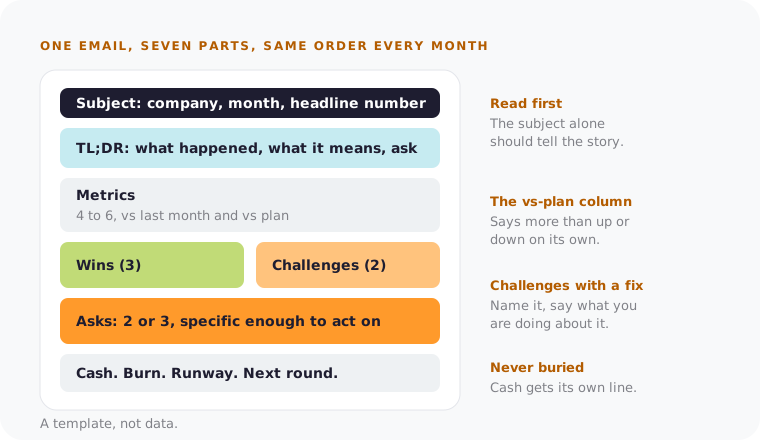
Same order every month, so investors know where to look.
1. Subject line: company, month, headline number
Write it like a headline. Someone who reads only the subject should know whether things are on track.
Weak: "Acme monthly update, April"
Better: "Acme, April: $84K MRR (+18%), churn up, raising Series A in September"
2. The summary: three lines
What happened, what it means, what you need.
TL;DR
- MRR $84K (plan $80K). 9 new customers. 3 churned, our worst month.
- Burn flat at $112K a month. 14 months of runway.
- Asks: 2 intros to security buyers, 1 interim engineering lead.
3. Metrics: against last month and against plan
Pick four to six numbers that fit your stage, and keep them the same every month. Show each one against last month and against the plan you shared.
                 April     vs March    vs plan
MRR              $84K      +18%        +5%
New customers    9         +1          on plan
Churned          3         +2          2 over plan
CAC payback      11 mo     +1 mo       2 mo over
Cash             $1.6M     -$112K      on plan
The "vs plan" column is the one that separates an update from a newsletter. Up is not the same as on track. Pick numbers that can go down too. A metric that only ever rises, like total sign-ups, tells nobody anything.
4. Wins: three, specific
- Signed Globex, our first customer outside fintech ($24K a year).
- Shipped audit logs on April 11. Two enterprise deals were waiting on it.
- Hired a head of engineering, starting May 6.
If a win cannot be checked, it is not a win. "Great customer feedback" is not one. "Three customers expanded seats" is.
5. Challenges: two, with what you are doing
- Churn tripled. Two of three were teams under 5 seats that never got
  set up properly. Talking to all three this week; we think onboarding
  for small teams is too thin.
- Two engineering offers declined for higher pay elsewhere. Raising the
  band on the next two roles.
Never write "no challenges this month". There always are, and investors know it. Naming them, with a plan, builds more trust than any win.
6. Asks: two or three, specific
1. Intros to heads of security at companies with 1,000+ staff.
2. An interim engineering lead for 8 weeks.
3. 20 minutes from anyone who has priced a three-tier plan.
"Any intros welcome" is easy to ignore. A specific ask is easy to act on.
7. Cash and runway: its own line, always
Cash $1.6M. Burn $112K a month. Runway 14 months.
Next round: Series A, planning to start in month 11.
If runway shrank faster than expected, say why here. Investors notice when "12 months" becomes "8 months" with no explanation, and they will assume the worst. Our runway guide covers when to start raising.
All the company names and numbers above are made up. Use the shape, not the figures.
A bad month, written well
The month you least want to write an update is the one where it matters most. Here is a hypothetical summary for a month that went wrong:
TL;DR
- MRR fell to $71K (plan $88K). Our largest customer paused for budget
  reasons; they say they will restart in Q3, we are not counting on it.
- Cut burn from $112K to $95K. Runway now 15 months.
- Ask: intros to two mid-market buyers in the same segment.
Three lines. The bad news is first, the response is second, and the ask makes it easy to help. An investor who gets that email knows what happened and what you are doing about it. An investor who gets silence has to guess.
Habits that make it work
- Monthly, on the same day. The first Monday of the month is easy to remember.
- Same template every time. Investors read these in batches. Familiar structure gets read properly.
- Plain text. It reads like a note from a person, and it renders the same on every phone.
- Short. One screen if you can. Link to detail rather than pasting it.
- Do not stop when it gets bad. Going quiet for six months and reappearing when you need money is the pattern investors tend to remember.
What to leave out
- Team quotes and photos.
- Long roadmaps. What you shipped, and whether it moved the number, matters more.
- General market commentary.
- Defensive framing. "I know this looks bad, but" is not needed. Say what happened.
Writing it faster with Claude
The first update takes longest. After that it gets quicker, and Claude can help with the mechanical parts: turning raw numbers into the metrics table, tightening a rambling challenge into two sentences, turning a vague need into a specific ask.
What Claude cannot do is supply the honesty. The challenges section has to come from you. A model will happily make a bad month sound fine, which is exactly what you do not want here. We learned this ourselves when our own follow-up drafts started inventing progress, and we had to restrict them to facts the founder had written.
What to do this week
- Pick your four to six metrics and write down the plan for each.
- Write this month's update using the seven parts, even if it is short.
- Name two real challenges. If you cannot, ask your team what is not working.
- Make two specific asks. A person, a role, a decision.
- Put the next send date in your calendar for the same day next month.
If you are preparing for a raise, the same discipline helps your deck. Our rubric guide explains what the traction dimension looks for, and our 12-slide guide shows where it belongs.
Before the next round
When you raise again, VC Boom scores your deck across seven dimensions, including traction, and ranks investors who fit your stage, sector and check size, from the 47,874 we track.
Score your deck for free and see how your traction reads to a new investor.