How many slides should a pitch deck have? The case for 12.
Picture a hypothetical founder, Nadia. Her deck is 23 slides. It has a vision slide, a three-year P&L, a tech stack diagram, a slide of logos labelled "trusted by", two competition slides and a thank-you slide. She built it to answer every question an investor could possibly ask.
She cuts it to 12 one evening. Nothing about the company changes. But the traction, which used to sit on slide 17, is now on slide 4, and it is the first thing a reader sees after the problem and the solution.
Nadia is made up. The 23-slide deck is not. We see a lot of them.
We want to be clear about what we can and cannot tell you here. We do not have data linking slide count to fundraising results. VC Boom scores decks, but it does not know which ones raised money. So this is not "decks with 12 slides raise 40% more". It is the reasoning for about 12 slides, plus what our scores say about where decks actually lose points.
What our scores say
Across 2,104 decks scored on VC Boom since April 16, 2026, the median overall score is 72, and only 5.3% score 80 or higher. The more useful number is underneath.
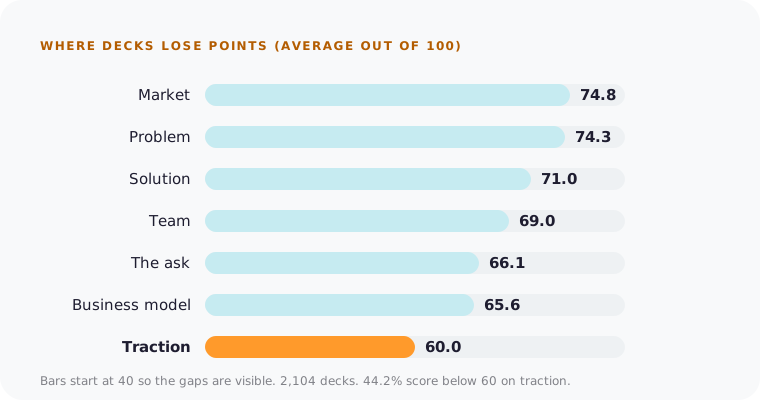
Market 74.8, problem 74.3, solution 71.0, team 69.0, ask 66.1, business model 65.6, traction 60.0.
Traction is the weakest dimension, averaging 60.0 out of 100, and 44.2% of decks score below 60 on it. Market and problem score highest.
None of that is about slide count directly. But it points the same way. Most decks are not missing slides. They have plenty of slides about the market and the vision, and too little early, clear proof that the business works. Adding slides rarely fixes that. Cutting slides often does, because it forces the proof forward.
Why about 12
The common advice is 10 to 15 slides for the main deck, with everything else in an appendix. We land at about 12 for three reasons. They are arguments, not measurements.
Attention is short. A deck sent cold gets skimmed. Every extra slide is another place where a busy reader stops. A slide that would win them over on page 19 often never gets read.
Cutting is a signal. A tight deck says you know what matters. A deck that includes everything can read as a founder who has not decided.
The deck's job is the next meeting. You do not need to answer every question in the deck. You need to earn the call where those questions get asked. "Happy to walk through the full model on a call" can replace three slides.
The 12 slides, in the order we would use
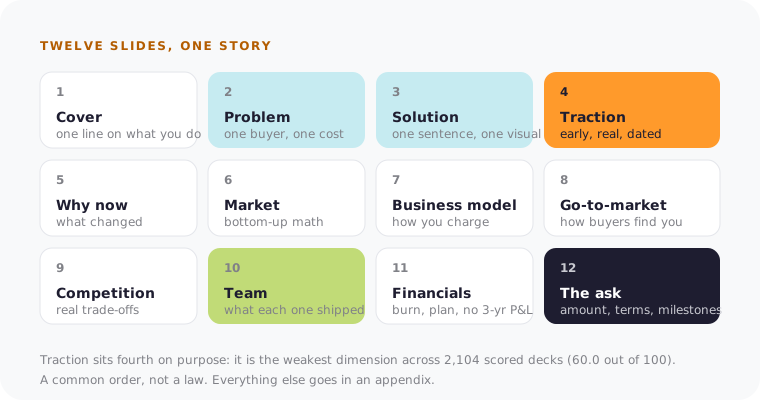
A common order, not a law. Traction sits fourth on purpose.
- Cover. Company name and one line on what you do, in words a friend would repeat.
- Problem. One buyer, one costly problem. Specific beats big.
- Solution. What you built, in one sentence and one visual.
- Traction. Real, dated numbers. Revenue, usage, pilots, letters of intent, whatever is true at your stage.
- Why now. What changed that makes this possible or urgent today.
- Market. Built from the bottom up: how many buyers, at what price.
- Business model. How you charge and what one customer is worth.
- Go-to-market. How customers find you, with any early numbers.
- Competition. Real competitors, honest trade-offs.
- Team. Why you, for this. What each person has shipped.
- Financials. Burn, runway and the plan. Not a three-year P&L.
- The ask. Amount, instrument, and the milestones the money buys.
The big change from many templates is traction at slide 4 instead of slide 8 or later. If traction is where decks lose the most points, it should not also be where readers have already stopped.
If you are pre-seed with no revenue, slide 4 is still traction. It just shows early signal instead: design partners, a waitlist that converts, a pilot with a named type of customer. Our scorer judges pre-seed traction on exactly those signals.
What slide 4 should look like
Here is a hypothetical traction slide that wastes its position:
Growing fast. Loved by users. Strong pipeline.
And the same slide, rewritten:
$18K MRR, up from $6K in February. 41 paying teams, 3 churned. Net revenue retention above 100% for the last 4 months. 2 enterprise pilots signed in June.
Both are made up. Only the second gives an investor anything to react to. If you have less to show, show less, but make it specific and dated. "8 design partners using it weekly since April" beats "strong early traction" every time.
What to cut
- The vision slide. If the vision is not clear by slide 3, a sunrise photo will not help.
- The three-year P&L. Keep one financials slide. The model goes in the data room.
- The roadmap 18 months out. Investors care more about what you have shipped.
- The tech stack. Diligence material, not pitch material.
- "Why we will win". That is what the whole deck is for.
- The thank-you slide. End on the ask.
- Duplicates. Two team slides, two market slides, two competition slides. Merge.
Everything you cut can live in an appendix. The appendix is for diligence, not the decision.
The six-minute test
Here is a simple check: pitch the deck out loud with a timer. Twelve slides at about 30 seconds each is six minutes. If you run well over, you either have too many slides or too many words per slide.
Cut, re-time, repeat. Each round tends to come out sharper than the last.
The one exception
Deep tech and biotech decks sometimes need more, because the science is the story and investors want to see validation data early. Even then, keep the main narrative tight and put the technical depth in a clearly marked appendix.
If you send decks cold
Cold outreach makes all of this matter more. The investor does not know you, so patience is shorter. Across 1,962 investor emails founders sent through VC Boom, 2.5% got a reply. When someone does click through to your deck, the first five slides are most of your chance. Our cold email guide covers the email that gets them there, and our rubric guide explains what each dimension in the score looks for.
What to do this week
- Count your slides. If it is over 14, block an evening.
- Move traction to slide 4. Date every number on it.
- Cut the seven slide types above into an appendix.
- Merge duplicates. One team slide, one market slide.
- Run the six-minute test and cut again.
- Score the new version. Check whether traction moved. Our guide on deck scores and replies explains why we fix the weakest dimension first, and what a score can and cannot predict.
See where your deck stands
VC Boom scores your deck across seven dimensions and tells you which slide to fix first, with a suggested rewrite. Then it ranks investors who fit your stage, sector and check size, from the 47,874 we track.
Score your deck for free and see whether your traction slide is pulling its weight.