Why your cold email is reaching the analyst, not the partner, and how to fix it in 90 seconds
Picture a hypothetical founder. Call her Lea. She has a decent seed deck, a clear story and a list of 40 funds. Over six weeks she sends 40 emails. Nothing comes back.
When she finally opens her sent folder and reads the "To" line, the problem is right there. Most of the emails went to info@, hello@ or contact@. A few went to the most famous partner at each firm, who does not invest in her sector. None went to the person whose job is to back a company like hers.
Lea is made up. The pattern is not. It is one of the most common reasons a decent email goes nowhere, and it is the cheapest one to fix, because you do not have to change a word of the email.
Why the address matters more than you think
A generic inbox is a queue. Someone triages it when they can. Your email might get read. It might get forwarded. It will rarely land in front of the partner you want, at a moment when they are thinking about your sector.
A partner's own inbox is not a guarantee either. Partners get far more email than they can answer. In our own data, across 1,962 emails founders sent to investors through VC Boom since April 16, 2026, the reply rate was 2.5%. That is the honest baseline for cold outreach. It is low enough that you cannot afford to waste sends on the wrong inbox.
There is a second reason the address matters, and we have numbers for this one. Every investor email in our database carries a verification status.
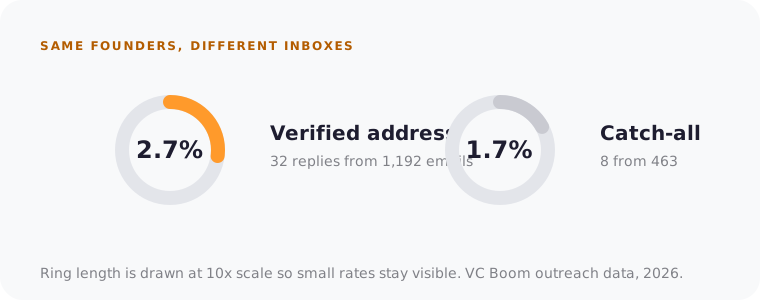
Verified addresses: 32 replies from 1,192 emails. Catch-all addresses: 8 from 463.
Verified addresses got a 2.7% reply rate. Catch-all addresses, domains that accept any email so you cannot tell whether a person is behind it, got 1.7%. One founder sent 834 of our 1,962 emails, so we checked the split without them: 3.0% against 2.0%. The gap holds.
We cannot tell you exactly why. Some catch-all addresses are dead ends that nobody reads. Some are fine. What we can say is that a verified address to the right person is a better bet than a guess.
Step 1: pick the right partner
Before you find an address, find the person. This is where "90 seconds" is a stretch, so let us be honest: the address takes 90 seconds, choosing the partner takes longer.
The right partner usually has three things:
- Their name is on a recent deal in your sector and stage. Portfolio pages and funding announcements name the partner who led.
- They write or talk about your space. A recent post, a podcast, a thread. This also gives you your first line.
- They are not the most famous person at the firm by default. The best-known partner is often busy with later-stage work or the firm's own fundraising.
If no partner at a firm matches, that is useful information. The firm may not be a fit. Our guide on building your first investor list covers that filter.
Step 2: find the firm's email pattern
Most firms use one format for everyone. Once you know it, you know every partner's address.
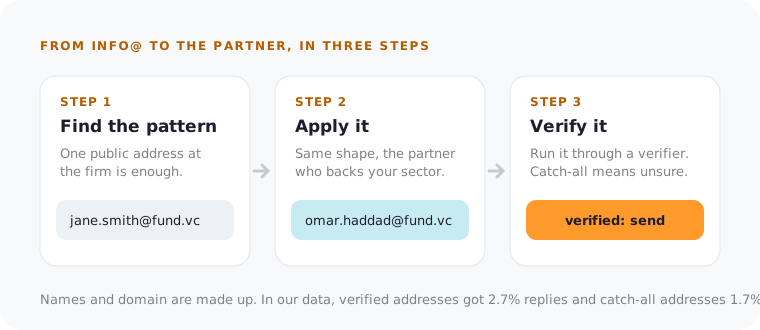
Find one public address, apply the same shape to the partner's name, then verify.
The common shapes are:
firstname.lastname@firm.comfirstname@firm.com, more common at small firmsflastname@firm.com(first initial plus last name)firstnamelastname@firm.com
To learn which one a firm uses, you need one real address from that firm. Places to look:
- The firm's own site. Team pages, press pages, privacy policies and job posts often include a real person's address.
- Press releases. Fund announcements often list a named media contact at the firm.
- The partner's own channels. Some partners publish their address on a personal site or newsletter so founders can pitch them. If they do, use it. They are telling you how they want to be reached.
- An email finder. Tools like Hunter show the pattern a domain uses, and most have a small free tier.
Watch for the edge cases. Two partners with the same first name often break the simple firstname@ pattern. Apostrophes are usually dropped. Long or double surnames vary by firm. When you are unsure, verify rather than guess.
Step 3: verify before you send
This is the step people skip, and it is the one our data says matters. A verifier checks whether the mail server will accept the address without sending anything.
You will get one of three answers:
- Valid. Send.
- Invalid. Do not send. Fix the pattern or find another route.
- Catch-all or unknown. The server accepts everything, so the check cannot tell. Send only if you have a strong reason to believe the pattern is right, and expect a lower hit rate.
We use MillionVerifier for our own database. After our last full pass, on August 19, 2026, 20,751 of the 47,874 investor records we track had a verified address. Hunter, NeverBounce and others do the same job. Most offer a few free checks.
Why bother? Bounces do more than waste a send. Mail providers watch how many of your emails bounce. Enough of them and your messages start landing in spam, including the good ones.
Do not "test" an address by sending a throwaway email to it. If the address is real, a stranger now has a pointless email from you, and you have used up your first impression.
What not to do once you have the address
A real address to the right partner is valuable. It is easy to waste.
- Do not send the same email to three partners at one firm. They talk. Pick one. If the fit is wrong, a partner will usually forward you to the right colleague.
- Do not CC info@ "just in case". It reads as a mass send.
- Do not open with flattery. Open with what you do and why it fits them. Our cold email guide has the shape that showed up in the replies we read.
- Do not chase faster than every few business days. Our follow-up guide covers timing.
What to do this week
- Open your sent folder. Count how many investor emails went to a generic inbox. That number is your quick win.
- For each firm, pick one partner with a recent deal in your sector and stage.
- Find one real address per firm and note the pattern in your spreadsheet.
- Build the partner's address from the pattern.
- Verify every address. Mark each one valid, invalid or catch-all.
- Re-send to the partner only where the first email went to a generic inbox, with a fresh, short email, not a forward of the old one.
How we handle this in VC Boom
When you upload your deck, VC Boom ranks investors from the 47,874 we track by stage, sector and check size, with the partner names and addresses we hold. We run those addresses through the same kind of verifier described above, so most of the pattern work is done before you start. The partner choice is still worth a minute of your own judgment.
Get your free shortlist and see which partners come up first.