Family Offices vs Micro-VCs at Seed: What Founders Should Know
Picture a hypothetical founder, Julien, raising a $1.5M seed. His list is 60 venture funds. A friend mentions that a family office in Geneva led a round for a company like his last year. Julien goes looking for its website and finds a single page: a name, an address, no portfolio, no email.
That is the family office problem in one scene. Some of them write exactly the checks seed founders need. Many of them are very hard to find, and they differ a lot from one another.
Julien is made up. This guide is about what we do know, what we do not, and how to add the right family offices to your list without wasting weeks.
What we can and cannot tell you
The earlier version of this guide floated a thesis: that family offices now compete head to head with micro-VCs for seed checks. We could not find data that proves it, so we are not repeating it.
What we can say is narrower and more useful. Family offices are a distinct kind of investor. Some invest directly in startups at seed. Their process, check sizes and expectations vary widely. And because many of them stay out of the public eye, the founders who include them usually do more research per name than for funds.
What a family office is
A family office manages the wealth of one family, or sometimes a few. Some only invest in public markets and property. Some put money into venture funds as an investor. Some invest directly in startups. Only the last group is directly relevant to your seed round, and it is often hard to tell which kind you are looking at from the outside.
A micro-VC, by contrast, is a small venture fund: it raises money from outside investors, has a fixed fund life, and exists to invest in startups. That structure makes it more predictable. Its check size is set by its fund size. It usually reserves money for follow-on rounds. Decisions go through a partnership.
Five questions to ask before the first call
Because family offices vary so much, the most useful thing we can give you is a set of questions, not a set of generalisations.
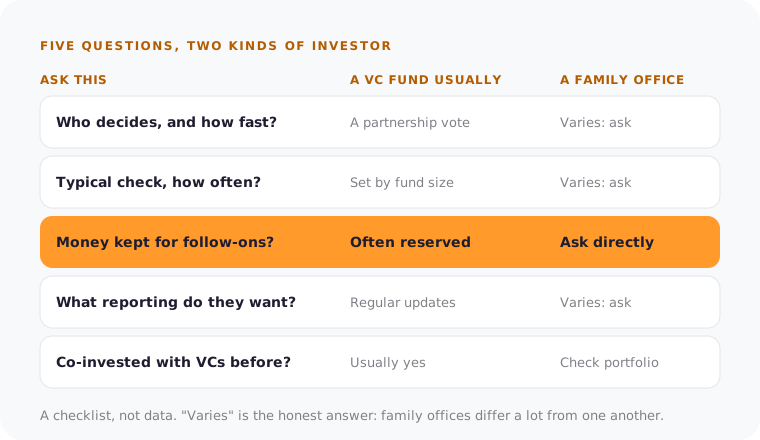
For a fund you can often guess the answer. For a family office, ask.
1. Who decides, and how fast?
At some family offices, one principal decides, and it can be quick. At others, an investment committee meets quarterly. Ask: "Walk me through how a direct investment gets approved here, and how long it usually takes."
2. What is a typical check, and how often do you write one?
Some write small angel-sized checks. Some only write large growth checks. Ask for a range and how many direct startup investments they made in the last year. An office that made one direct investment in three years is not an active seed investor, however interested it sounds.
3. Do you keep money back for follow-on rounds?
This is the one that matters most for your cap table. Funds usually reserve money for follow-ons. Family offices may or may not. If a large part of your seed comes from investors who will not follow on, your Series A has to be led entirely by new money. Ask directly.
4. What do you expect after you invest?
Some want a short quarterly note. Some want a board seat. Ask before you take the money, not after.
5. Have you invested alongside venture funds before?
A family office that has co-invested with funds knows how rounds work: the documents, the timeline, how a lead sets terms. One that only invests alone may need more hand-holding. Check the portfolio, if there is one, and ask.
How to find them
Family offices are harder to find than funds because many have no portfolio page, no thesis and no public contact. A few ways in:
- Ask founders who raised recently in your city. Founders know who actually wrote checks, and some family offices prefer to invest close to home.
- Ask your existing angels and advisors. Family office principals tend to move in networks that overlap with angels.
- Read round announcements. When a family office co-invests in a seed round, the announcement often names it.
- Use a list built for this. We publish free regional family office lists: the Riviera, the Nordics, DACH, the UK, Europe, the Middle East, Asia and the USA, plus the vault. All of them are at /lists.
A list gets you names. It does not tell you which ones invest directly at seed today. Use the five questions to qualify each one, ideally before a call, by email or through someone who knows them.
How to approach them
Family offices tend to respond to the same things funds do: clear fit, checkable proof and a specific ask. A few differences are worth knowing.
Lead with who you are and why them. If the family made its money in logistics and you build logistics software, say so in the first line. Expertise in your sector is often the reason a family office invests directly.
Expect a slower or less formal process. Some move quickly. Some take months. Keep your fund outreach going in parallel. Across 1,962 investor emails founders sent through VC Boom, 2.5% got a reply, so silence is normal from any kind of investor.
Keep the batch small. Founders who sent 25 emails or fewer got replies to 9.3% of them, against 1.2% for founders who sent more than 100. That is an association, not proof, but it is a good reason to research ten family offices properly rather than email a hundred.
Verify the address. Family office addresses are often generic or catch-all. In our data, verified addresses got 2.7% replies against 1.7% for catch-all. Our guide on reaching the right person covers how to check.
The cap table question
None of this means you should avoid family office money. It can be patient, flexible and well connected. It means you should know, before you sign, how much of your round is likely to support you at the next one.
A simple test: list every investor in your seed round and mark which ones have told you they reserve money for follow-ons. If that column is mostly empty, plan your Series A on the assumption that new investors will have to lead and fill it.
What to do this week
- Open the family office list for your region and pick 15 names that look relevant to your sector.
- Qualify each one on the five questions, as far as public information allows.
- Keep the 5 to 10 that look like direct seed investors.
- Find a warm path where you can, through founders or angels in your city.
- Write to the rest with a clear reason why them, proof and a specific ask. Our cold email guide has the shape.
- Keep your fund outreach running in parallel. Our European seed VC guide covers funds if you are raising in Europe.
Build the rest of the list
Family offices are one part of a seed list. VC Boom ranks venture funds, angels and family offices that fit your stage, sector and check size, from the 47,874 investors we track.