How to research investors for free, without a Crunchbase seat
The first version of this guide had a number in its title: it said Crunchbase costs "$50K a year". That was wrong. Crunchbase sells individual plans for far less, and the big figure was a guess at enterprise pricing that we could not back up. We changed the title, and while we were at it we rewrote the guide.
The point survives the correction. You do not need a paid database to research an investor properly. Most of what matters before a first email or a first call is public and free. It just lives in five different places, and nobody tells you which order to check them in.
This is the routine we would use for one fund. It takes about an hour.
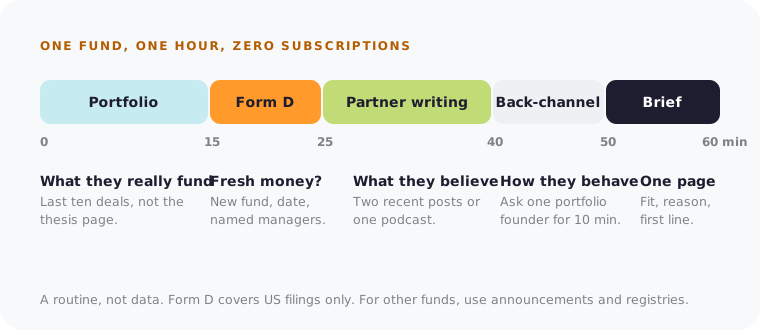
Portfolio, Form D, the partner's writing, a back-channel, then a one-page brief.
What you are trying to learn
Before the sources, the questions. For each fund on your shortlist you want five answers:
- What do they actually fund? Stage, sector, geography, based on deals rather than the tagline.
- Do they have money to invest right now?
- Who would lead a deal like yours?
- What does that person believe?
- What are they like to work with?
A database can help with the first three. The last two only come from reading and asking.
Minutes 0 to 15: the portfolio page
Start with the firm's own site, and go straight to the portfolio. It is observed behaviour. The thesis page is what they say; the portfolio is what they did.
Read the last ten companies, newest first if the page allows it. For each one, note the sector, roughly what stage it was at when the fund came in, and whether any of them competes with you. A direct competitor in the portfolio is usually a pass, and it is better to learn that now.
Then read the team page. Look for the partner whose name keeps appearing next to companies that look like yours.
What the site will not tell you: check sizes, terms, or how the partner behaves when things go wrong.
Minutes 15 to 25: SEC Form D
This is the most underused free source we know of for US funds.
When a venture fund raises money from its own investors in the US, it usually files a Form D with the SEC. You can search them for free on SEC EDGAR. Search the fund's legal name, which often looks like "Example Ventures Fund III, L.P.", and open the most recent Form D. It shows:
- When the fund made its first sale, which is a good proxy for when new money arrived.
- How much it is raising and how much it has sold so far.
- The related persons, usually the managers behind the fund. That list is a quick way to confirm who is senior.
A fund that filed for a new vehicle recently has fresh money to put to work. A fund whose last filing is years old may still be investing from reserves, but it is worth asking.
We run this check across our own database. Here is what came back when we matched investor records to Form D filings.
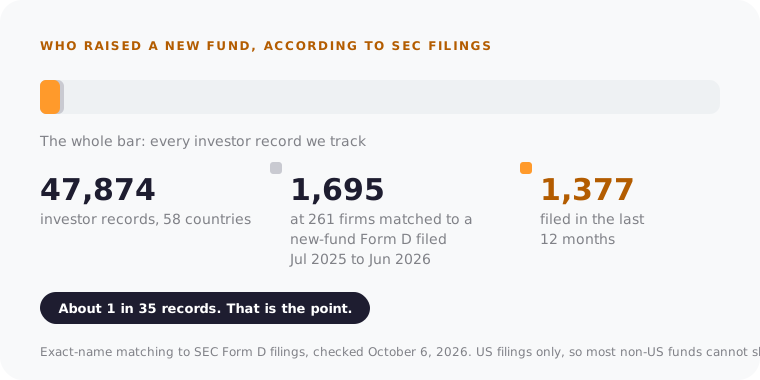
1,695 records at 261 firms matched a new-fund Form D filed between July 2025 and June 2026. 1,377 of them filed in the last 12 months.
Two honest limits. Our matching is exact-name, so it misses funds whose filing name differs from their brand. And Form D is a US filing. Angels never file one, and most non-US funds do not show up. For a European fund, look for a fund-close announcement on its own site or in the trade press, and for UK funds, the public register at Companies House can confirm a fund entity exists.
Minutes 25 to 40: the partner's own writing
Most active partners leave a public trail: a newsletter, a blog, posts on LinkedIn or X, podcast appearances. Two recent pieces tell you more about how this person thinks than any database field.
Read for three things:
- What they are excited about right now. If it is close to what you do, that is your first line.
- What they are sceptical of. If your pitch leans on exactly that, address it early.
- The words they use. Not to parrot them, but to describe your company in terms they already care about.
Searching the partner's name with "podcast" or "newsletter" usually finds it. If you find nothing, that is fine. Some good investors do not write in public.
Minutes 40 to 50: a founder back-channel
The most valuable thing you can learn about an investor is what their founders say about them. No database has it.
Pick two founders from the partner's portfolio. Send each a short, honest note:
Hi [name], I am raising a seed round and [partner] at [fund] is on my list. Would you be up for a 10-minute call about what they are like to work with? Happy to return the favour any time.
Not everyone replies. The ones who do usually tell you the truth, especially about how the investor behaved when things were hard. Good questions to ask:
- "How fast and how clear were they during the deal?"
- "What do they actually do after the money arrives?"
- "Has their pushback ever helped? Has it ever hurt?"
- "Would you take their money again?"
You will often do this later in the process, once there is real interest. That is fine. Send the request now so the call is ready when you need it.
Minutes 50 to 60: a one-page brief
Write it down while it is fresh. One page per fund:
Fund:            Example Ventures III
Partner:         [name], led [comparable] seed in [year]
Fit:             seed, B2B logistics, Europe and US
Fresh money:     Form D, first sale [date]
They believe:    [one line from their writing]
Watch out for:   [competitor in portfolio? scepticism?]
Back-channel:    requested from [founder], [date]
First line:      [the sentence that opens your email]
The last row is the one that pays. When you sit down to write the email, the first line is already there.
When a paid database is worth it
Paid tools earn their price when you need breadth, not depth: mapping every seed fund in a sector across three countries, exporting lists, filtering thousands of firms at once. That is a different job from researching the 25 investors you will actually email.
Use a database, ours or anyone's, to find and rank the long list. Use the free routine above for the short list. Our guide on building your first investor list covers how to get from one to the other.
What to do this week
- Take the top 10 funds on your list. Not 50. Ten.
- Run the one-hour routine on each. Ten hours total, spread over the week.
- Search EDGAR for each US fund. Note the date of the latest Form D.
- Send two back-channel requests for your top three funds.
- Write the brief, including the first line. Then use it in your cold email to the right partner.
If you want the long list done for you
VC Boom ranks investors from the 47,874 we track by stage, sector and check size, using your deck. We check SEC filings and firm portfolio pages, and show the date we checked. The hour of reading per fund is still yours, and it is worth it.
Get your free shortlist and start your research with the 25 who fit.