Cold email vs warm intros: what our cold numbers say, and what they can't
The old version of this guide had "what the numbers say" in its title. It also had a section about seed funds feeding partner inboxes into AI tools that rank cold emails, which was a nice story we could not support.
Here is the problem with the comparison itself. We have good numbers on cold email. We have no numbers on warm intros. Introductions happen in someone else's inbox, and we never see them. So any "cold vs warm" chart from us would be half data and half guess.
What we can do is tell you exactly what cold email looks like, so you can judge it against your own warm options. Then we will show you how we would run both at once.
What cold email actually looks like
Since April 16, 2026, founders on VC Boom have sent 1,962 cold emails to investors. Fifty got a reply.
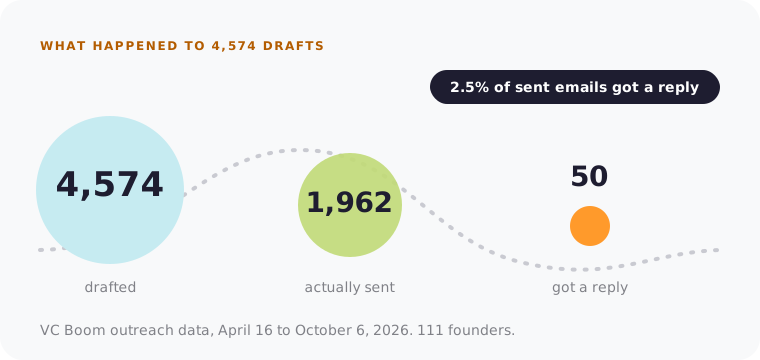
The cold funnel, start to finish.
That is a 2.5% reply rate. Of the 111 founders who sent, 21 got at least one reply.
If that sounds low, it is. It is also more honest than most of the cold email numbers floating around, which rarely say how many founders they came from. When we checked our own early numbers, one founder had sent 834 of the 1,962 emails. Any pattern we found had to survive removing that one person.
Two patterns did survive.
Fewer, better-fit emails.
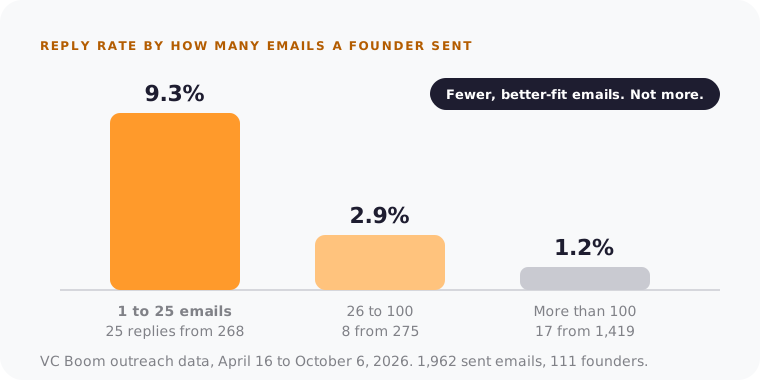
Founders who sent 25 or fewer emails in total: 9.3% replies. More than 100: 1.2%.
This is an association, not proof. Founders with a stronger company or an obvious fit may need fewer sends. But it means cold email is not a numbers game you win by volume.
Real addresses. Verified addresses got 2.7% replies, catch-all addresses 1.7%. Without the largest sender: 3.0% against 2.0%.
What we think about warm intros, clearly labelled as opinion
We have no data here, so this section is judgment.
A warm intro is only as warm as the person making it. An introduction from someone the investor trusts, who knows your work and says so, is the best door into most funds. An introduction from someone who met you once and forwards your deck with "thought you might find this interesting" is not much warmer than a cold email, and investors can tell the difference.
The cost of warm intros is time. You ask, they agree, they forget, you nudge, they send. A week is fast. A month is common. And while you wait, many founders send nothing else.
That waiting is the real risk. Cold email has a low reply rate, but it starts today.
How we would run both at once
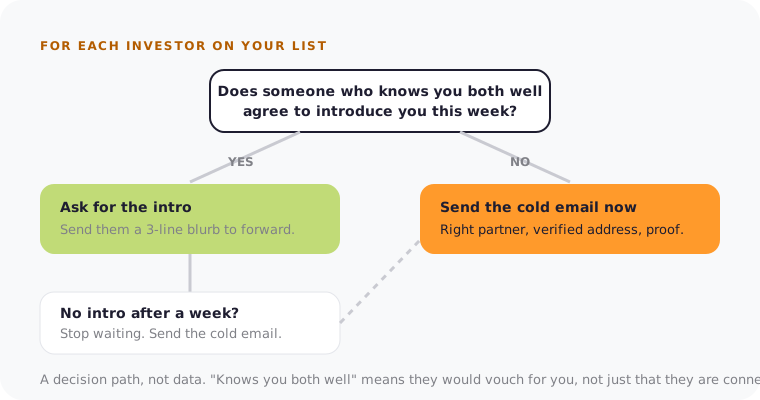
For each investor on your list. A decision path, not data.
For every investor on your list, ask one question: is there someone who knows you both well, and who will make the intro this week?
If yes, ask for the intro. Make it easy. Send them a three-line blurb they can forward as it is:
[Name] is building [company], [what it does in one line]. They have [strongest proof]. Raising [amount] [stage]. I think it fits your work on [area]. Happy to connect you two?
If no, send a cold email now. To the right partner, at a verified address, leading with checkable proof. Our cold email guide has the shape that showed up in the replies we read, and our guide on reaching the right partner covers the address.
If the intro has not happened after a week, send the cold email anyway. Do not wait a month for an intro that may never come. If the intro arrives later, it lands on top of an email the investor has already seen, which does no harm.
The result: your whole list is in motion within a week, the strongest warm paths get used, and nothing stalls on a favour.
A worked example
Here is how that plays out for a hypothetical founder, Priya, with a list of 25 seed investors. Priya and her numbers are made up.
She goes through the list on Monday morning. For 4 investors she has a real warm path: two through an angel who knows the partners well, one through a former colleague who now works at a portfolio company, one through a founder the fund backed last year. She sends each introducer the three-line blurb before lunch.
For 6 investors she has a weak path, someone who is connected but would not really vouch for her. She treats those as cold. For the other 15 she has no path at all.
By Monday afternoon, 21 cold emails are out, each to the right partner at a verified address. By the following Monday, three intros have happened. The fourth introducer has gone quiet, so Priya sends that investor a cold email too.
Within eight days, all 25 investors have heard from her. Nothing waited on a favour. Compare that with the common alternative: four weeks chasing intros, then sending cold emails in week five.
What makes cold email work better
From reading the 50 emails that got replies, and from the data above:
- The right person. A partner who backs your stage and sector, not a general inbox.
- A verified address. Catch-all addresses replied less often in our data.
- Proof an investor can check, in the first three lines. An approval, a patent, signed revenue, named pilots.
- The round in one sentence. Amount, stage, what it pays for.
- A small ask. "Worth 20 minutes this week?"
- A short list. About 25 at a time, chosen carefully. Our guide on building your first investor list walks through it.
Length mattered less than we expected. Emails that got replies had a median of 116 words; silent ones, 124. That is a small gap on a small sample, so do not cut useful facts to hit a word count.
When warm really matters
Some investors are very hard to reach cold. Funds that are famous enough to receive a flood of email are the obvious case. If one of those is a top target and you have a real path to a trusted intro, it is worth the wait for that one fund. Just do not let it hold up the other 24.
What to do this week
- Go through your list and mark each investor: real warm path, weak warm path, or none.
- For real warm paths, ask today. Send the forwardable blurb.
- For weak or no paths, send the cold email today. Verified address, right partner.
- Set a reminder for seven days out. Any intro still pending gets a cold email.
- Follow up on cold emails after five business days. Our follow-up guide has the cadence.
Make the cold half easier
VC Boom ranks investors who fit your stage, sector and check size from the 47,874 we track, and drafts a first cold email from your deck in the shape above. The warm half is still yours, and it should be.
Score your deck for free and see who comes up first.