The family office playbook: who to contact, and why
Here is a founder we made up. Her week is real enough: versions of it come up again and again when founders tell us how their raise is going.
She runs a seed-stage company selling software to logistics firms. On Monday she asks an AI tool for family offices that invest in logistics technology. She gets 20 names. By Wednesday she has sent 20 emails. Ten days later she has two polite declines and a lot of silence.
Her conclusion: family offices do not back companies like hers.
That is the wrong conclusion. What actually happened is that she sent her first search. A few of those names were private banks that call themselves family offices and never write a direct cheque. A few only invest through funds. Several had backed nothing in logistics, ever. And the office that might have said yes, the one owned by a family that built its money in freight, was not on the list at all. It sat one or two steps beyond the obvious result.
This playbook is the system for going from "I need investors" to "I know who I should contact, and why". No inflated numbers, and no promise of a magic response rate.
First, what makes a family office different
A venture fund invests other people's money on a clock. It raised a fund, it has a few years to deploy it, and it publishes a thesis so founders know what to send. You can research a VC from the outside.
A family office invests its own money, and nobody makes it explain itself. That changes three things.
They can be patient, and they can say no without a reason. There is no fund cycle forcing a decision. That cuts both ways.
They are hard to research from the outside. Many have a thin website or none, no thesis page, and no public team. The research you would do on a VC comes back mostly empty. You learn about a family office through its deals, the business that made the family's money, and the people around it.
Many do not invest in startups directly at all. Some only invest through venture funds. And plenty of firms on "family office" lists are wealth managers serving many clients, which rarely write a direct cheque into a seed round.
Single-family and multi-family offices
A single-family office serves one family. The team is small, and decisions often sit close to the principal or a family member. Its interests tend to follow the industry the family built its wealth in, plus whatever the family personally cares about. That makes single-family offices unpredictable, and it is also why a great fit can appear out of nowhere: a family that made its money in freight may understand your logistics software better than any generalist fund.
A multi-family office serves several families. It has more process, often an investment committee, and it looks and behaves more like a wealth manager. Direct startup deals are less common, and when they happen they often come as co-investments alongside a lead. The person you talk to may have to sell your deal to their clients, so give them something they can forward.
A quick tell: if the website talks about "our clients", you are probably looking at a multi-family office or a wealth manager, not a single family.
The six steps
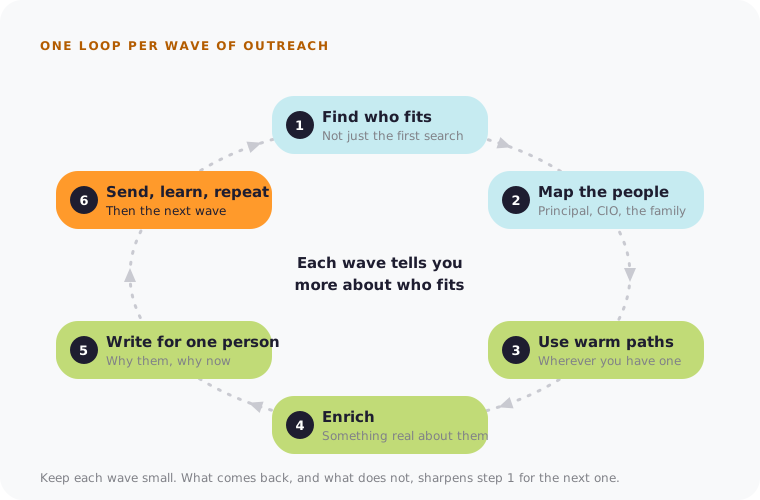
One loop per wave of outreach. Each wave teaches you something about step 1.
1. Find the investors who actually fit
Do not stop after the first search. The first search gives you the names every founder in your sector finds, and emails. The useful investor is often one or two steps beyond that.
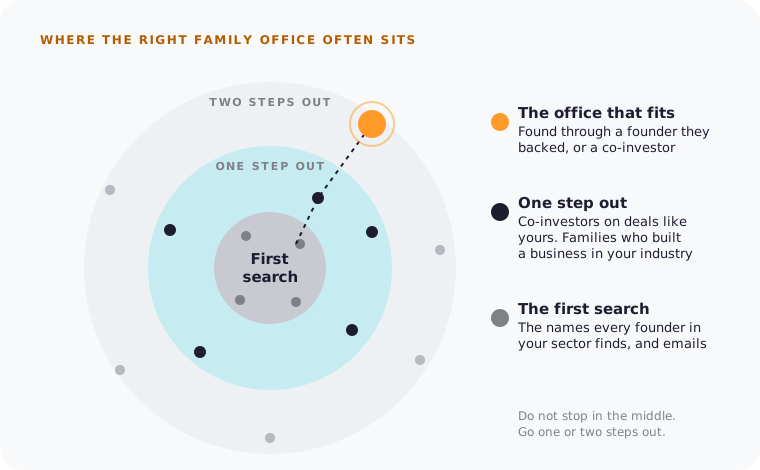
The first search sits in the middle. The office that fits is often further out, reached through a co-investor or a founder they backed.
Ways to take that step:
- Read the round announcements of companies like yours. They list every investor, including family offices that never appear in a search for "family offices investing in X".
- Follow the money back to its source. Which families built their wealth in your customer's industry? They already understand the problem you solve.
- Ask founders they backed. A founder in an adjacent space can tell you who else sits on their cap table, and whether the office was any good to work with.
- Look at who advises them. Lawyers, accountants and private bankers who work with families often host the dinners and the deal flow.
2. Map the people behind the firm or family office
You are never pitching "the office". You are pitching a person: the principal, a family member, a chief investment officer, an investment director, or an analyst who screens deals before anyone else sees them.
At a single-family office, the family member who is curious about startups and the professional who manages the money may want different things. Know which one you are talking to, and what each would need to hear.
3. Use warm paths wherever you can
Family offices invest on trust, and some do not look at cold pitches at all. Before you write cold, check every route in: founders they backed, funds they invest in, co-investors, their advisers, your own investors and angels.
When someone agrees to introduce you, make it easy. Send them a short note they can forward as it is, so they do not have to describe your company in their own words.
4. Enrich each target with something real about them
"I admire your track record" is not research. Something real is: a direct deal they did and why it sits near yours, the industry the family built its wealth in, an interview the principal gave, the focus of the family's foundation.
One real thing per target is enough. If you cannot find one, that office goes back on the list until you can.
5. Write the message for that specific person
The shape is simple. Why them, using the real thing from step 4. What you do, in plain words. One proof point they can check. The round. A small ask.
Keep it short. Do not stretch your numbers to sound bigger. An investor who later finds out a claim was inflated does not reply to the next email, and the family office world is small.
6. Send, learn and repeat
Send in small waves. Then write down who replied, who passed and why, and who stayed silent, and let that change step 1 before the next wave.
Here are the honest numbers from our own data, across all investor types, not only family offices. Founders on VC Boom have sent 1,962 emails to investors, and 2.5% got a reply. Founders who sent 25 emails or fewer got replies to 9.3% of them. Founders who sent more than 100 got 1.2%.
That gap is associated with sending fewer, better-chosen emails. It does not prove that sending less causes replies, since founders with an obvious fit may simply need fewer emails. But nothing in it supports blasting a long list and hoping.
The channel depends on where the office sits
How you make the first contact matters as much as what you say, and it changes by region. These are practical patterns that we, and the founders we talk to, keep running into. They are not statistics, and plenty of individual offices break them.
- The Nordics lean email-first. A clear, short, factual email is often the expected way in, and you are more likely to get a clear answer, including a clear no.
- Paris rewards meeting in person. An email may get you a coffee, and the coffee does the work. If you can be in the city for a few days of meetings, say so.
- The Gulf leans on warm intros and LinkedIn first. Trust tends to come through people the office already knows, and a visit in person counts. Expect more than one meeting before any decision.
- Asia works much the same way. Warm intros and LinkedIn come first, and the standing of the person introducing you matters.
Everywhere else, ask. The quickest way to learn how an office likes to be approached is to ask the person introducing you, or to look at how the founders they backed first got in touch.
Using Claude well
AI is good at the reading and bad at the judgment, unless you force it to show its work. Four habits make the difference: give it your deck, ask it to define the investor profile, push it to find companies and funds that look like you, and make it explain why each investor belongs before it writes a word.
Turn on web search for all of these. Without it, the model answers from memory, and memory is where invented deals come from.
1. Define the profile from your deck.
Read the attached deck. Describe the family office that would be the
best fit for this round: single or multi-family, the industries the
family likely built its wealth in, direct or through funds, cheque
size, region, and what they would need to believe about us. Then
describe a family office that looks right but is wrong for us.
2. Find companies that look like you, and who backed them.
Find companies similar to ours ([one sentence on what you do]) that
raised at [stage] in the [last two years]. For each round, list every
investor and mark any family offices. Then go one step further: who
else have those family offices backed? Cite a source for every deal.
If you cannot find a source, write "not found".
3. Make it explain why each one belongs, before writing anything.
For [family office], answer with sources only:
- Single or multi-family? Direct deals or only through funds?
- Which direct startup deals have they done, and when?
- How close is the nearest one to us, and why?
- Have they backed a competitor of ours?
- Who there handles direct investments?
Then give a verdict: belongs on my list, maybe, or no, with one line
of reasoning. Label anything you infer. Never guess an email address.
4. Find the person and the route in.
For [family office] in [city or region], who handles direct startup
investments, and how do they prefer to be approached: email, an
introduction, LinkedIn, or an event? Here are people I know who
might be connected: [names]. For each possible path, show the public
evidence of the connection. Do not assume any connection without it.
5. Write for one person, and list the claims.
Write a short first message to [person] at [family office]. Open
with why them, using [the real thing from step 4]. Then what we do,
one proof point they can check, the round, and a small ask. Do not
invent traction, quotes or connections. After the message, list
every factual claim in it so I can check each one.
If you want more, our 50 investor research prompts cover the whole process step by step, and work for VCs as well as family offices.
Start from a list, not a blank page
We publish free family office and investor lists by region. Use one as your long list, then run it through the six steps above. None of them is a list to email in one go.
If you want the shortlist built for you
VC Boom ranks investors against your stage, sector and cheque size, across the 47,874 investor records we track, family offices included. Find the 25 investors who fit your raise, or upload your deck for a free score and a ranked list.
Then do the part no tool can do for you: find the one real thing, and write to one person.