How Sourcer Cuts 47,000 Investors Down To 90 Who Can Say Yes
A founder sent me his outreach tracker last March. Four hundred and twelve names, colour coded, sorted by fund size, eleven weeks of work behind it. He had sent 380 emails and booked four calls, two of which were analysts doing market research on his sector.
The list was not the problem. The list was the symptom.
Sourcer is not a search tool. It is a subtraction tool.
The number that matters is not 47,000
There are 47,000+ investors reachable in the VC Boom database. That number is useless to you.

The database at vcboom.com/investor. Every active VC, family office and angel writing cheques in 2026, refreshed weekly from primary sources. Impressive, and completely unusable until you subtract from it.
The number that matters is the one on the other end. For any given round, somewhere between 60 and 120 investors are genuinely right. Right stage. Right cheque. Right sector. Actually deploying.
Everything outside that band is noise that looks like progress. A 400-name list feels like momentum because it took three weeks to build. It is not momentum. It is three weeks.
The job of Sourcer is to get you from 47,000 to under 120 without you spending eleven weeks discovering which 47,000 minus 120 were wrong.
The five filters, in the order that matters
Sourcer narrows on five things. Stage, cheque size, sector, geography, and whether the fund has actually deployed capital in the last twelve months.
Four of those are what you would expect. The fifth is the one that does the work.
Stage. Not the stage you want to be at. The stage your traction supports. A fund that writes Series A cheques will read your pre seed deck as a Series A deck and reject it on Series A criteria.
Cheque size. Set the band you actually need, not the band you would like to announce.
Sector. Broad enough to catch adjacent theses, narrow enough to exclude generalists who list your sector on a website and have never funded it. If you are unsure where that line sits, what a fund says its thesis is versus what it actually funds is the distinction to learn first.
Geography. Where the fund writes, not where the fund has an office.
Recent deployment. Has this fund put money into a new company in the last twelve months.
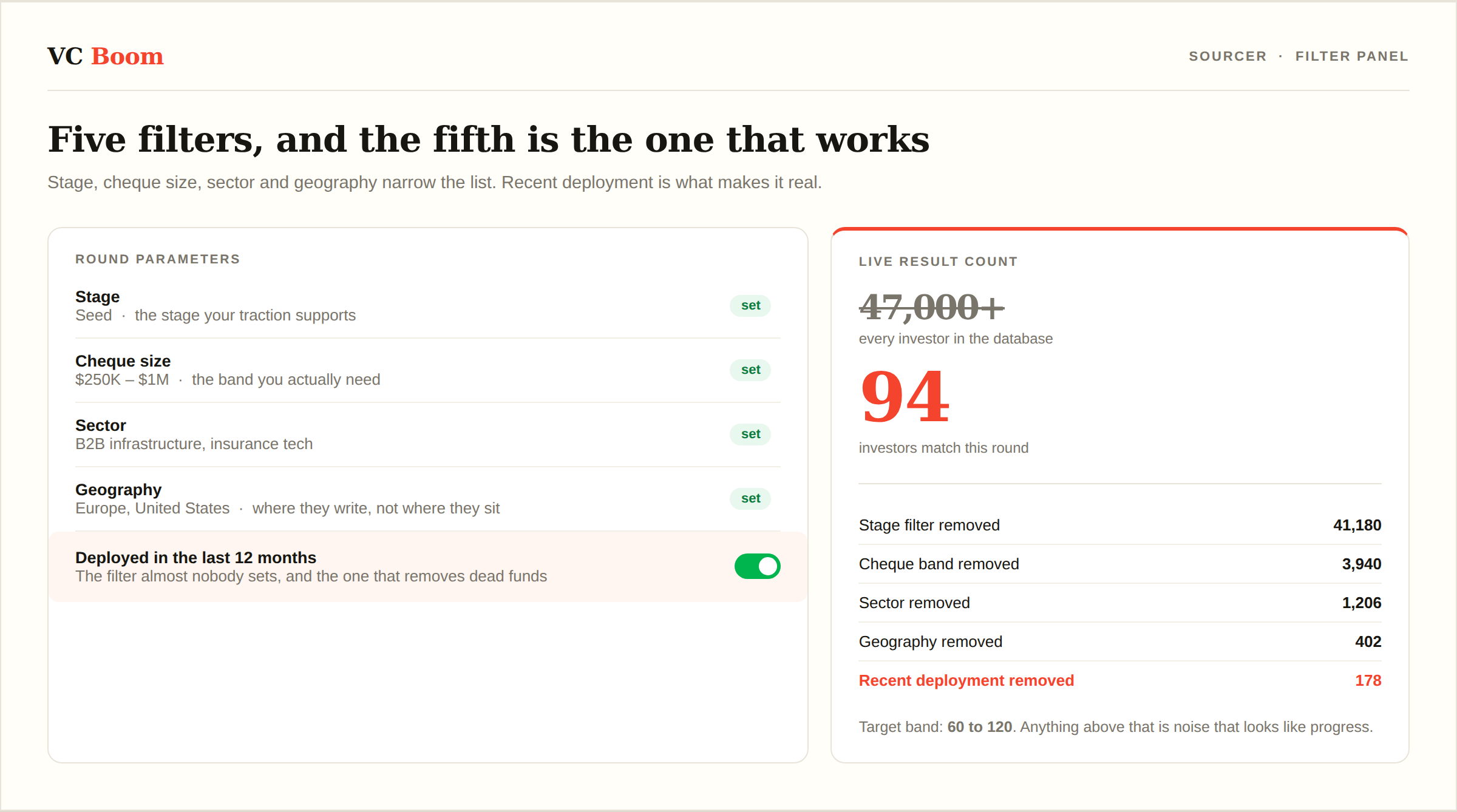
The five filters, and the live count as they narrow. Stage, cheque, sector and geography do the bulk of the work. Recent deployment is what stops you emailing funds that have stopped writing cheques.
Recent deployment is the filter almost nobody sets
Stage will always remove the most rows. That is arithmetic, and it is not interesting. Recent deployment removes the fewest rows and it is the one that changes the list, because the names it removes are the ones that would have cost you the most time.
A large number of funds are listed everywhere. Directories, conference sites, the partner's LinkedIn headline, your accelerator's shared spreadsheet. They look active. They are not active.
They are between funds. Or the partner who covered your sector left. Or LP commitments stalled and nobody updated the website.
They are effectively out of market and they will still take your call, because taking calls costs a partner forty minutes and costs you a week of hope.
When you turn the deployment filter on it will only take a handful of names off a list that is already narrow. Those are the names that would have eaten a month. That is not a bug in your list. That is what your list always was.
Set stage and cheque honestly or the rest breaks
Here is the failure mode I see most.
A founder raising $1.5M sets the stage to Series A because it sounds better, and the cheque band to $2M to $5M because he plans to raise more later.
Sourcer returns a clean, credible, well matched list of funds whose minimum cheque is larger than the entire round.
Every one of those funds will pass. Not because the company is bad. Because a fund with a $3M minimum cannot deploy $500K into your round without breaking its own model. You are asking someone to do something their fund documents forbid.
Set the stage you are at. Set the cheque you need. The list gets smaller and it gets real.
The same discipline applies to sector. Founders widen the sector field when the count drops below a hundred, because a hundred feels thin. A hundred is the target, not the warning.
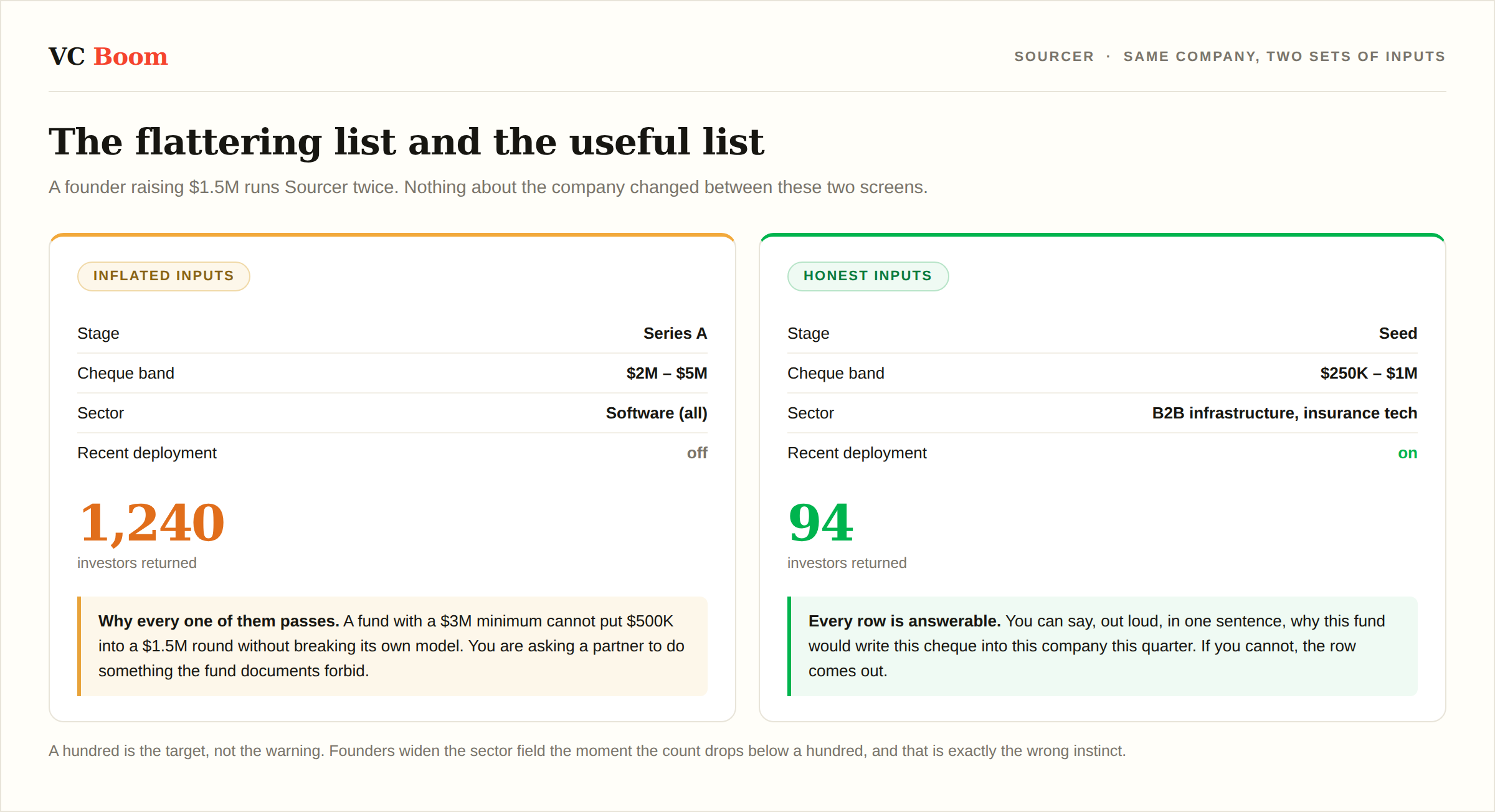
Inflated inputs on the left, honest inputs on the right. The 1,240 list feels better for about a day.
The test for every row
Once you are under 120, run one test.
Pick any single row. Explain, out loud, in one sentence, why that fund would write this specific cheque into this specific company this quarter.
If you cannot, delete the row.
Not "they invest in climate." That is a category, not a reason. The reason sounds like: they led a seed in an adjacent hardware company fourteen months ago, they have a partner who spent six years in the industry, and their last three cheques were in your band.
Most founders can do this for about sixty rows and stall. Sixty defensible rows beats four hundred hopeful ones. Building the first hundred names properly is a slower exercise than it looks, and the slowness is the point.
If your sector comes back crowded on the fund side, vertical saturation will tell you whether you are competing for attention against forty similar companies in the same partner's inbox.
What you do with the list
You do not email 120 people on Monday.
You sort by fit, take the top thirty, and work them properly with warm paths where they exist. The remaining ninety are the second and third waves, and they stay useful for the whole raise because they were qualified once, properly, at the start.
Founders who do this compress the timeline. The seed round timeline data shows where raises actually stall, and it is almost never at the pitch. It is at the top of the funnel, in the weeks spent contacting people who were never going to write the cheque.
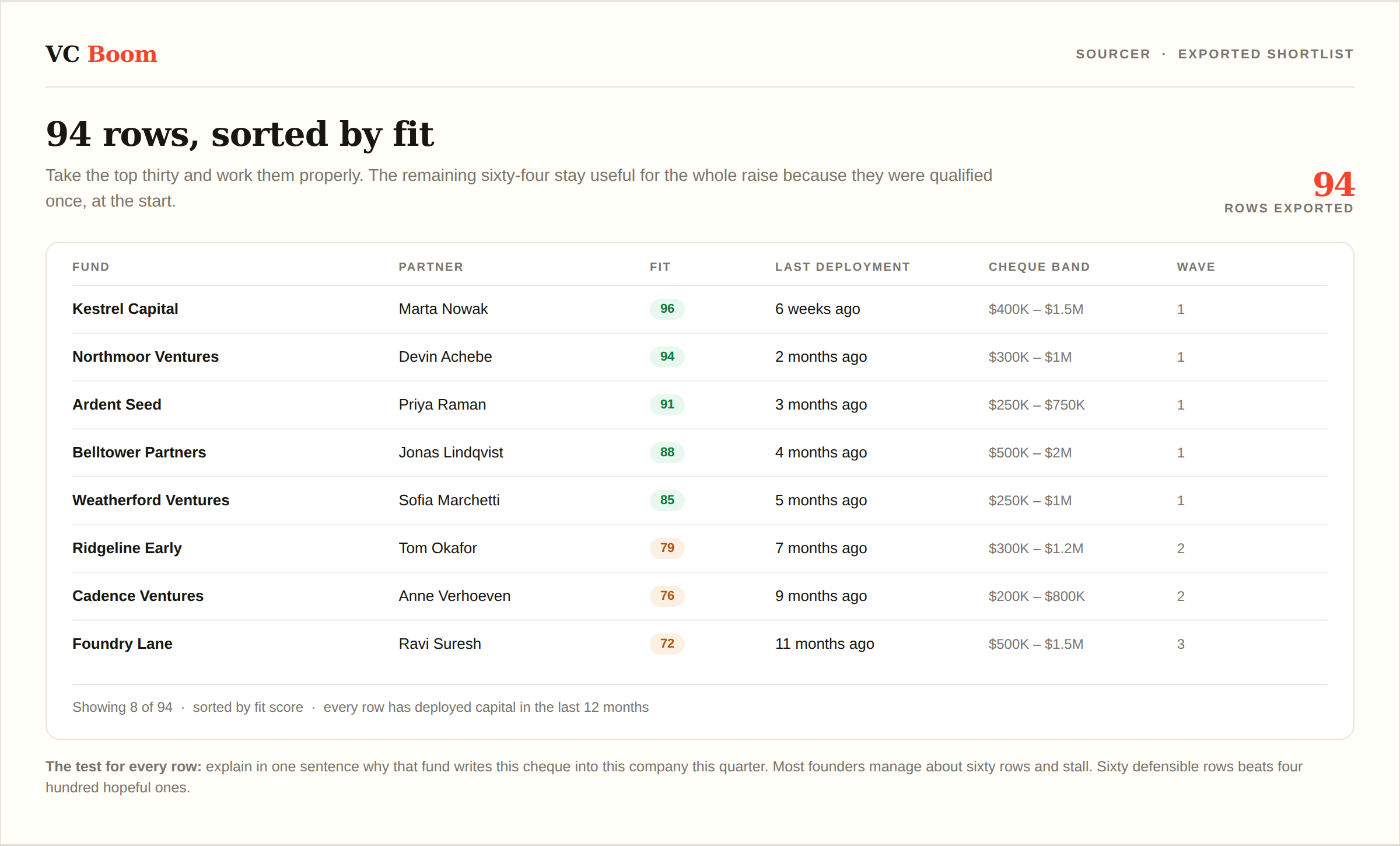
The export. Fit score, last deployment date and cheque band on every row, so the order you work it is decided before you open your inbox.
What the platform has seen
1,820 decks scored. $148M+ raised. 1,264 founders have run the system end to end.
The pattern across those raises is consistent. The founders who close are not the ones with the longest lists. They are the ones who cut hardest and earliest, and then went deep on what survived.
If you want to see the raw data before you filter anything, the public investor directory and the VC fund directory are open. Browse them once. You will understand the 47,000 problem in about four minutes.

The tier one names are all in there, which is exactly the trap. Do not pitch the tier. Pitch the three to five funds where your stage and sector actually map to their last twelve months of activity.
Then go build a list of ninety.
You can run Sourcer against your round at vcboom.com, and if the list comes back at four hundred names, you have not finished setting the filters. Set the stage you are at, the cheque you need, and turn on recent deployment. The list that survives is the one worth working.