How to Use Outreacher to Send Cold Investor Emails That Get Replies
A founder I know spent three days on one email. Four hundred words. Traction, team, market size, a paragraph about why now. He sent it to sixty partners on a Sunday night and refreshed his inbox for a week.
Two replies. Both were polite passes from analysts.
The email was not bad. It was just long, and long reads as anxious.
Here is the reframe: your cold email is not a pitch. It is a request for twenty minutes, written by someone who already knows the answer is probably no.
What Outreacher actually does
Outreacher writes the cold email using your deck data plus that specific partner's context.
Not a template with the name swapped in. It pulls what you already uploaded, the numbers, the stage, the category, and it pulls what we know about the partner, what they have written cheques for, what they have said publicly, where their fund sits in the stack.
Then it writes something short.
The output runs 120 to 150 words. That is deliberate, and it is the single design decision people push back on hardest.
Long emails read as pitching. Short emails read as a founder who knows what they have.
We have written up the underlying numbers separately, so I will not relitigate it here. The short version is that every additional paragraph gives a partner one more reason to decide later, and later means never.
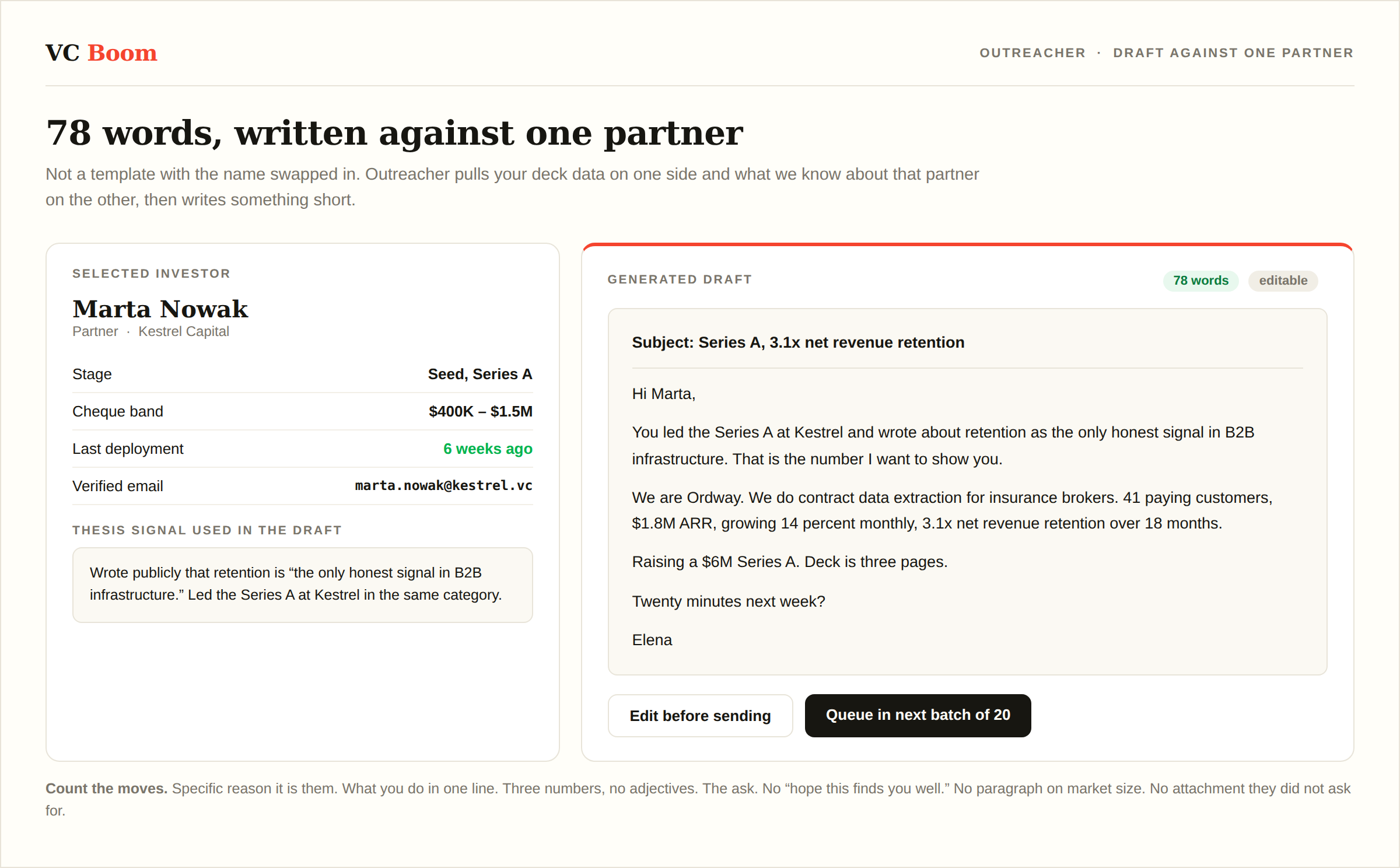
The investor on the left, the draft on the right. A short email, three numbers, one reason it is them. Everything you would normally pad it with has been left out on purpose.
The emails are editable, and you should edit them
This matters more than the generation.
Outreacher gives you a draft. It does not give you a send button you are supposed to hit blind.
Read it out loud. If a phrase is not how you talk, change it. If the agent picked the wrong proof point, swap it for the one you would actually lead with in a room.
The emails are meant to sound like you, not like AI. A partner who reads forty of these a week can tell the difference in one line, and the tell is almost never vocabulary. It is rhythm.
Across 1,300+ tracked sends on the platform, the drafts that get edited before sending outperform the ones sent untouched. Not because the agent writes badly. Because the founder's edit is what makes it sound like a person.
What the structure looks like
Here is a generic version of what Outreacher produces. Use it as a shape, not as copy.
Subject: Series A, 3.1x net revenue retention
Hi Marta,
You led the Series A at Kestrel and wrote about retention as the only honest signal in B2B infrastructure. That is the number I want to show you.
We are Ordway. We do contract data extraction for insurance brokers. 41 paying customers, $1.8M ARR, growing 14 percent monthly, 3.1x net revenue retention over 18 months.
Raising a $6M Series A. Deck is three pages.
Twenty minutes next week?
Elena
Count the moves. Specific reason it is them. What you do in one line. Three numbers, no adjectives. The ask.
No "hope this finds you well." No paragraph on market size. No attachment they did not ask for.
If you want the annotated version with the variants that tested best, it is in our cold email investor template for 2026.
Send in batches of 20, not 200
This is the part people skip, and it is the part that decides the outcome.
Send 20. Wait 72 hours. Read which subject lines got opens before sending the next batch.
Two hundred sends at once feels like progress. It is not progress. It is spending your entire list on a hypothesis you have not tested.
Twenty gives you a signal in three days. If the subject lines are landing, you send the next twenty with confidence. If they are not, you have burned twenty names instead of two hundred, and you still have a list.
The subject line is where most of the variance lives. The gap between the best and worst performing subject-line formats is wider than the gap between a good email body and a mediocre one.
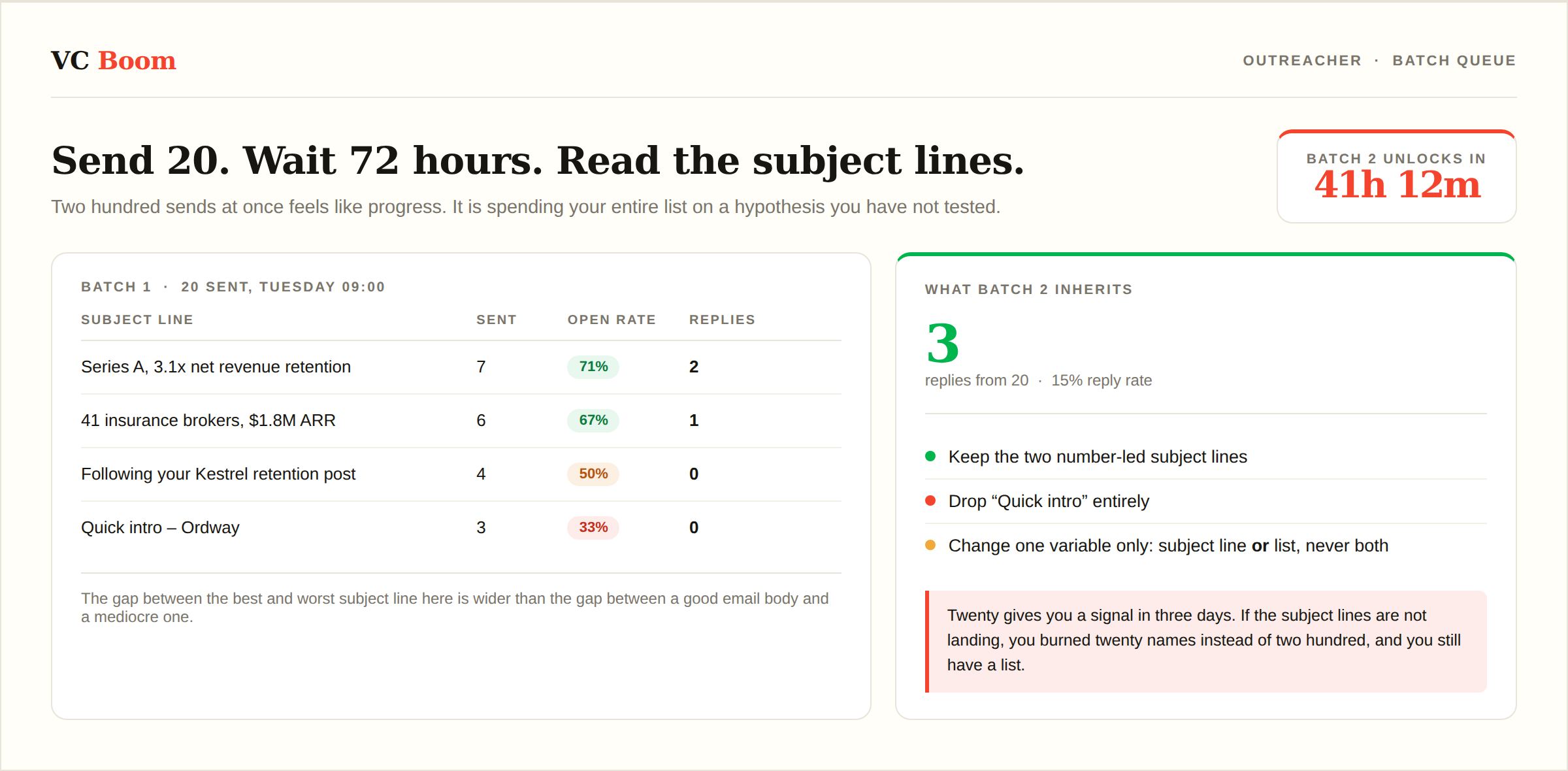
Twenty out, then the door closes for seventy-two hours. The subject line table is the only thing you should be reading in that window.
Send Tuesday at 9am
Tuesday 9am outperformed Monday across 1,300+ tracked cold emails.
Monday morning is when a partner triages the weekend. Your email is competing with a portfolio company fire and a Monday partner meeting.
Tuesday 9am, the triage is done and the week has not gone sideways yet.
The full picture, including why Monday feels like the right day and is not, is in our Monday pitch day data.
How to read the results
This is the diagnostic, and it is simple enough to hold in your head.
Target: reply rate above 15 percent.
Above 15 percent, your email and your list are both working. Keep sending, keep the cadence, do not get clever.
Between 8 and 15 percent, the email is doing something and the list is doing something, and your job is to isolate which. Change one variable in the next batch of twenty. Subject line or list, never both.
Under 8 percent, stop editing the email.
The problem is the list, not the email. No amount of rewriting fixes a batch of partners who do not invest at your stage, in your sector, or out of a fund size that makes your round worth their time.
Go back to the sourcing step. Rebuild the list against the 47,000+ investors in the database, filter harder on stage and cheque size, and start again with twenty.
Founders spend weeks rewriting an email that was never the problem. The reply rate tells you which one you have. Read it and act on it.
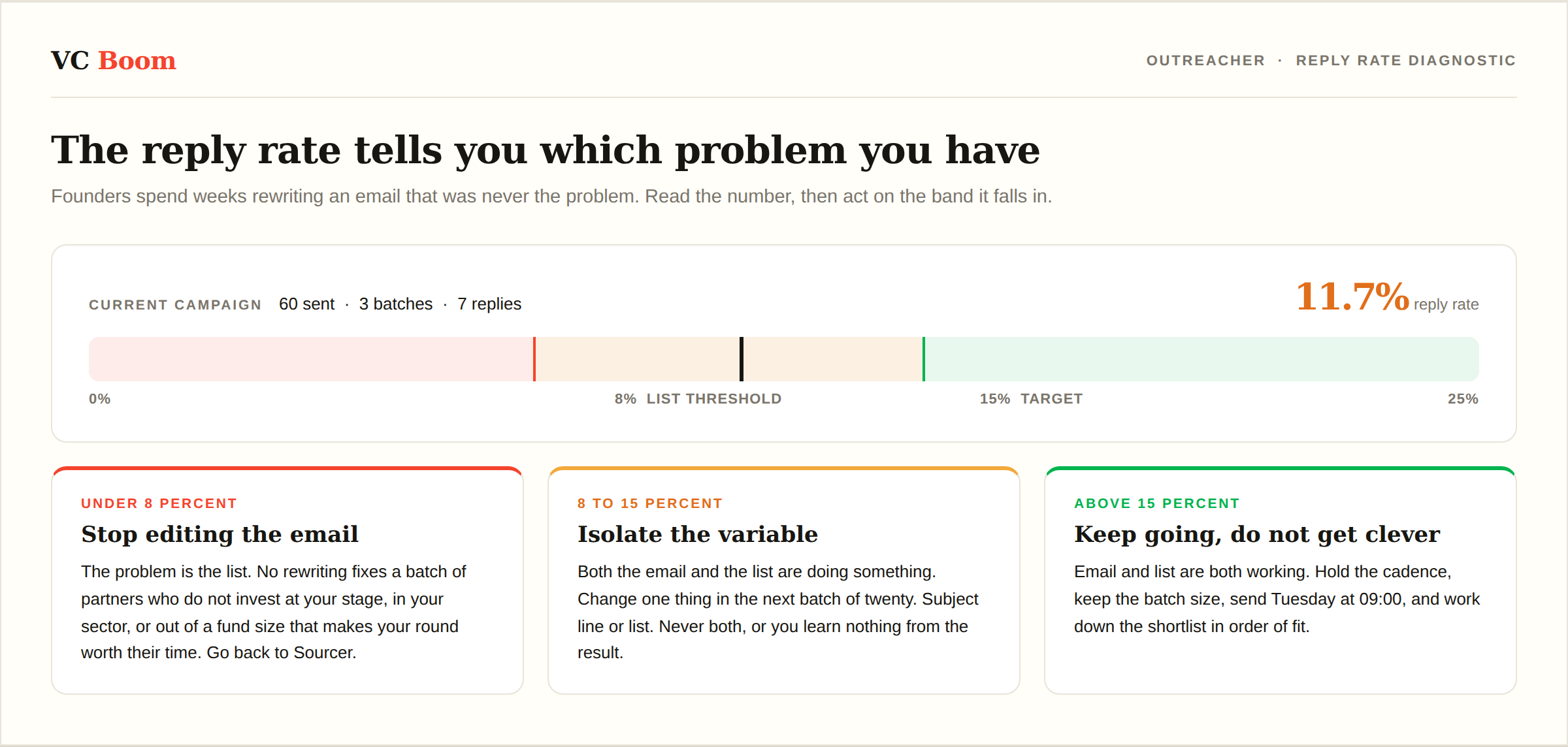
Three zones, three different instructions. Under 8 percent is a list problem, not a writing problem, and no amount of editing the email will fix it.
What to do after they reply
A reply is not a meeting. Most first replies are a question, a request for the deck, or a soft deferral.
The cadence after that point has its own rules, and the follow-up timing matters roughly as much as the first send. That is covered in our follow-up cadence for investor outreach guide.
One thing to hold onto. Cold email is not the weaker cousin of the warm intro. Across 1,820 decks scored and $133M+ raised through the platform, a specific cold email to the right partner beats a vague warm intro to the wrong one, consistently.
If you have no network, you are not out of the game. You are just doing the sourcing work that other founders outsourced to their alumni list.
Run Outreacher on your next twenty at vcboom.com, send them Tuesday at 9am, and read the number three days later. It will tell you whether to keep writing or go back to the list.