The Investor Memo a Partner Forwards Without Editing
A founder I know got the reply every founder wants. A partner at a fund she had chased for four months wrote back: "This is interesting, let me take it to the team." She replied in nine minutes with a thank you and the deck attached again. She never heard back.
The deck was not the problem. The problem was that she made a partner do her writing for her.
When a partner says they will take it to the team, they are telling you they are about to become your salesperson in a room you are not in. Give them something to sell.
Why the deck stops working the moment someone says yes
A deck is a performance aid. It assumes you are there, talking over it, filling the gaps between slides with tone and answers.
Strip you out and a deck becomes fourteen images with no argument connecting them.
Your partner cannot forward that to three colleagues on a Tuesday and expect them to arrive at the same conclusion he did. So he does one of two things. He writes the memo himself, badly, from memory, at 11pm. Or he does not bother, and your deal quietly stops moving.
We scored 1,820 decks before we understood this. The decks that converted after a warm reply were not better decks. Those founders had a second document.
The document nobody teaches you to write
The investor memo is two pages. Not eight. Not a data room. Two pages of narrative that a partner can forward without rewriting a line.
It is not a summary of your deck. It is the argument for your deck, written for someone who was not on the call.
That last part is the whole discipline. The reader you are writing for has never met you, has no context on your category, and is deciding in the eleven minutes between two other meetings whether to spend an hour on you. Everything in the memo has to work for that person.
Partners do not decide alone. Your memo is the document that argues your case in a Monday partner meeting you will never attend.
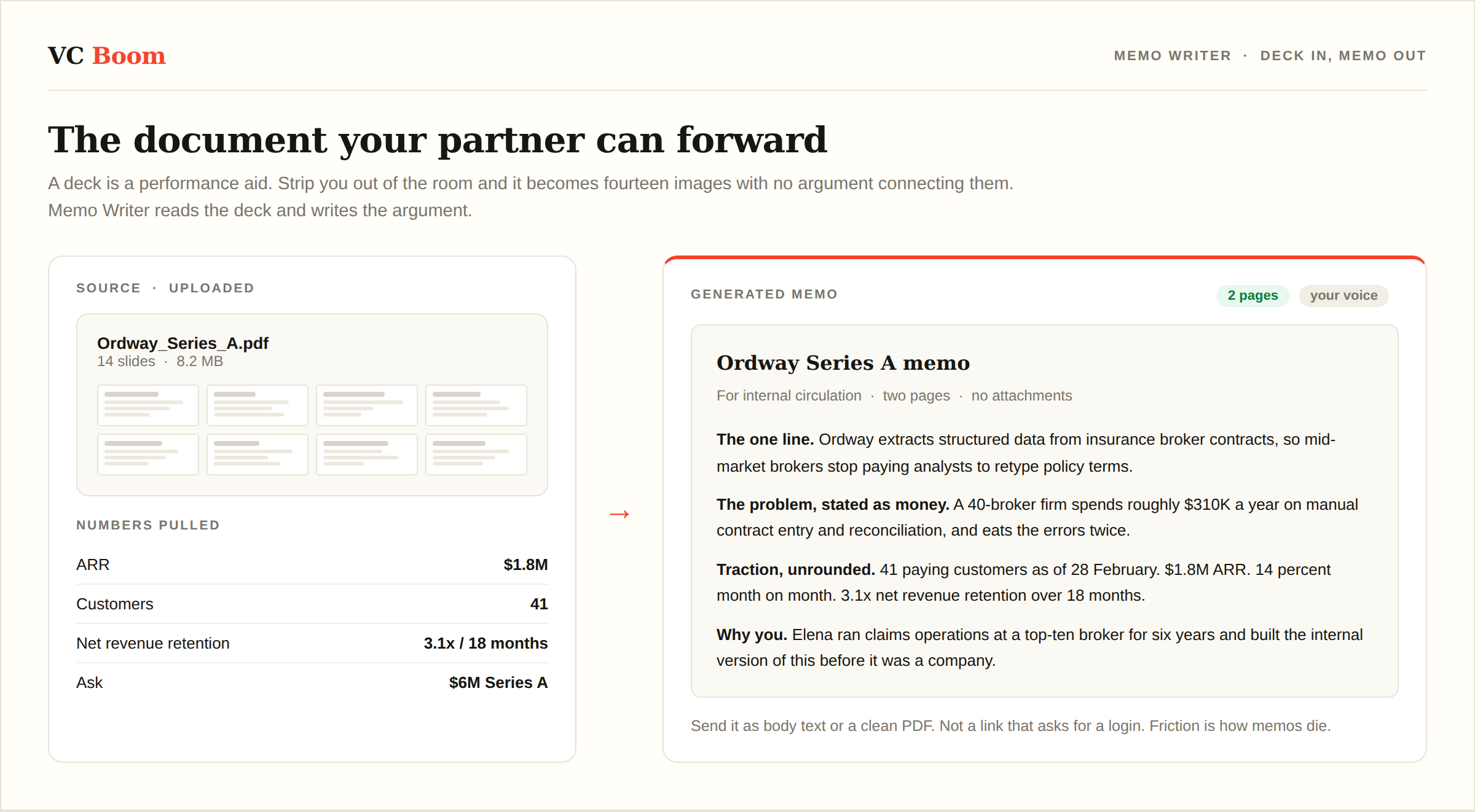
Deck on the left, memo on the right. It pulls your own numbers through rather than asking you to retype them, which is where most founders quietly round.
Monday is the deadline you did not know you had
We looked at meeting timing across our investor data. Monday is when most partner meetings happen. That is not folklore, it is what the calendar says, and we wrote it up in the Monday pitch day data breakdown.
Which means your warm reply on Wednesday has a hard delivery window.
If your memo does not exist by Friday, your deal gets discussed from a partner's memory of a call he took six days earlier. Memory is a terrible advocate.
What goes on page one
Page one is the case. If someone reads only this page, they should be able to argue for you.
The one line. What you do, for whom, and why now. No metaphor. No "we are the Stripe of." If a colleague can repeat this sentence back after one read, it works.
The problem, stated as money. Not as a societal condition. Who is currently losing what, measured in a number they can check.
What you built. Two or three sentences. Not features. What it does that the incumbent cannot.
Traction, unrounded. Revenue, users, retention, pipeline, whatever your real number is. Give the raw figure and the date. Rounded numbers read as decoration. Precise numbers read as a company that knows its own books.
Why you. The founder line. Not your CV. The specific reason you, and not a smarter team, will win this.
That is page one. It fits, and it fits because you cut things.
What goes on page two
Page two is the objection handling. This is the page that survives contact with the skeptic in the room.
Market, defended. Not a top down number. Bottom up: unit of demand, count, price. The pitch deck narrative arc guide covers the sizing logic in more depth.
Competition, named. Name the real competitors, including the one everyone in the room is thinking about. If you leave them out, someone else says the name and you are not there to answer.
The risks you already know. Two or three, written plainly, each with what you are doing about it. This is the single most underused paragraph in venture. A founder who names her own risks reads as someone who has thought harder than the reader.
The ask. Amount, structure, what it buys, what milestone it gets you to. Then the round status: who is in, how much is committed, what the timeline is.
Diligence readiness. One line on what is available immediately. Match it to the VC due diligence questions most funds open with, so the next request is a link, not a delay.
Two pages. Nothing else attached on first send.
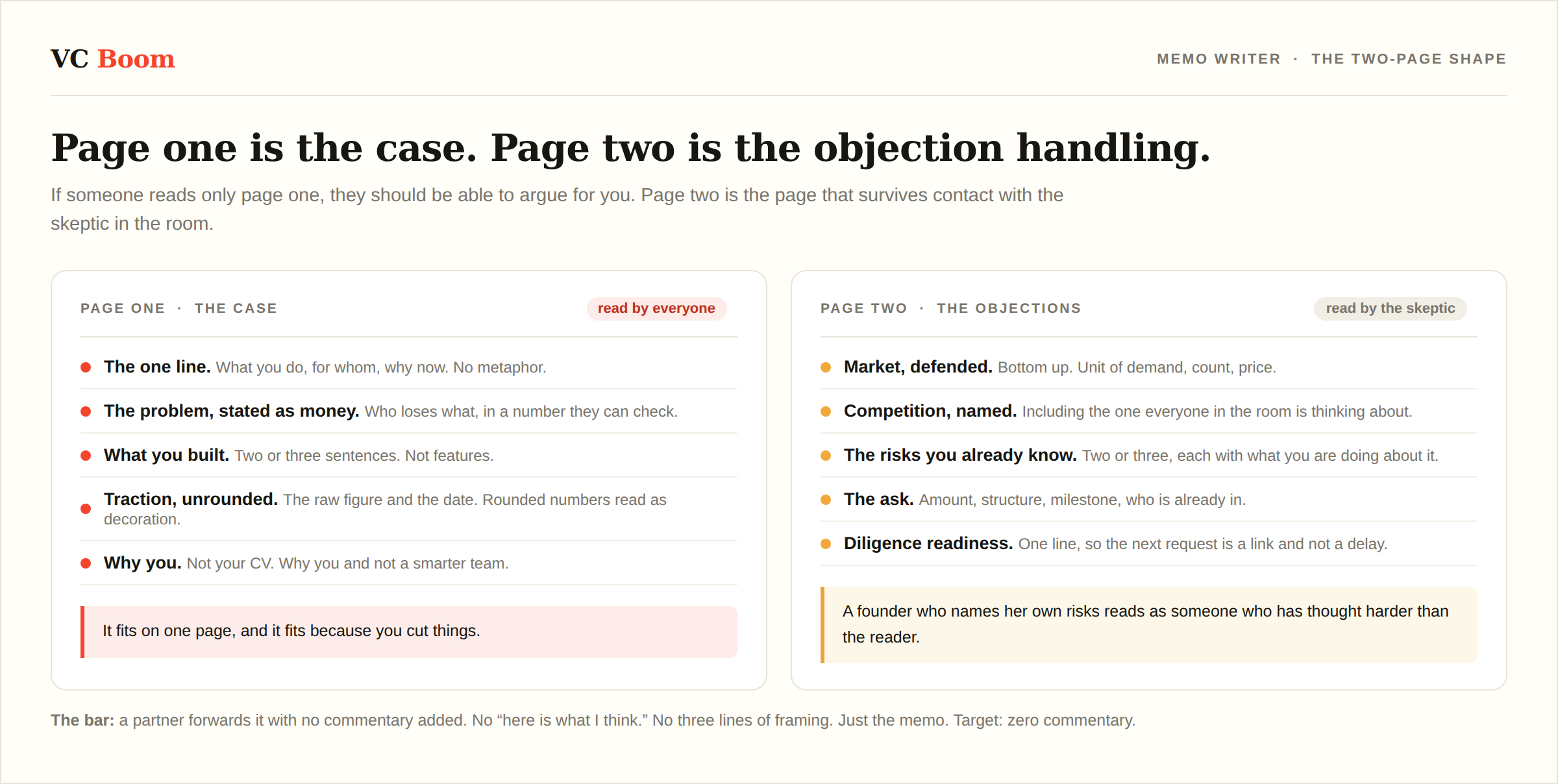
Page one is what gets forwarded. Page two is what survives the partner who was not in the room.
Running Memo Writer
Point Memo Writer at your deck and your numbers. It reads what you have and drafts the memo in the structure above, in your voice, not in the voice of a consultant.
Then do the one thing that matters.
Cut the first paragraph. Almost always throat clearing. The model warms up like a human warms up, and paragraph two is where the actual argument starts. Delete paragraph one and read it again. It will be better nine times out of ten.
After that, three passes. Replace every rounded number with the real one. Delete every adjective doing work a number should do. Read it as the partner who was not on the call and mark anything you cannot verify.
Send it as body text in the email or as a clean PDF. Not a link that asks for a login. Friction is how memos die.
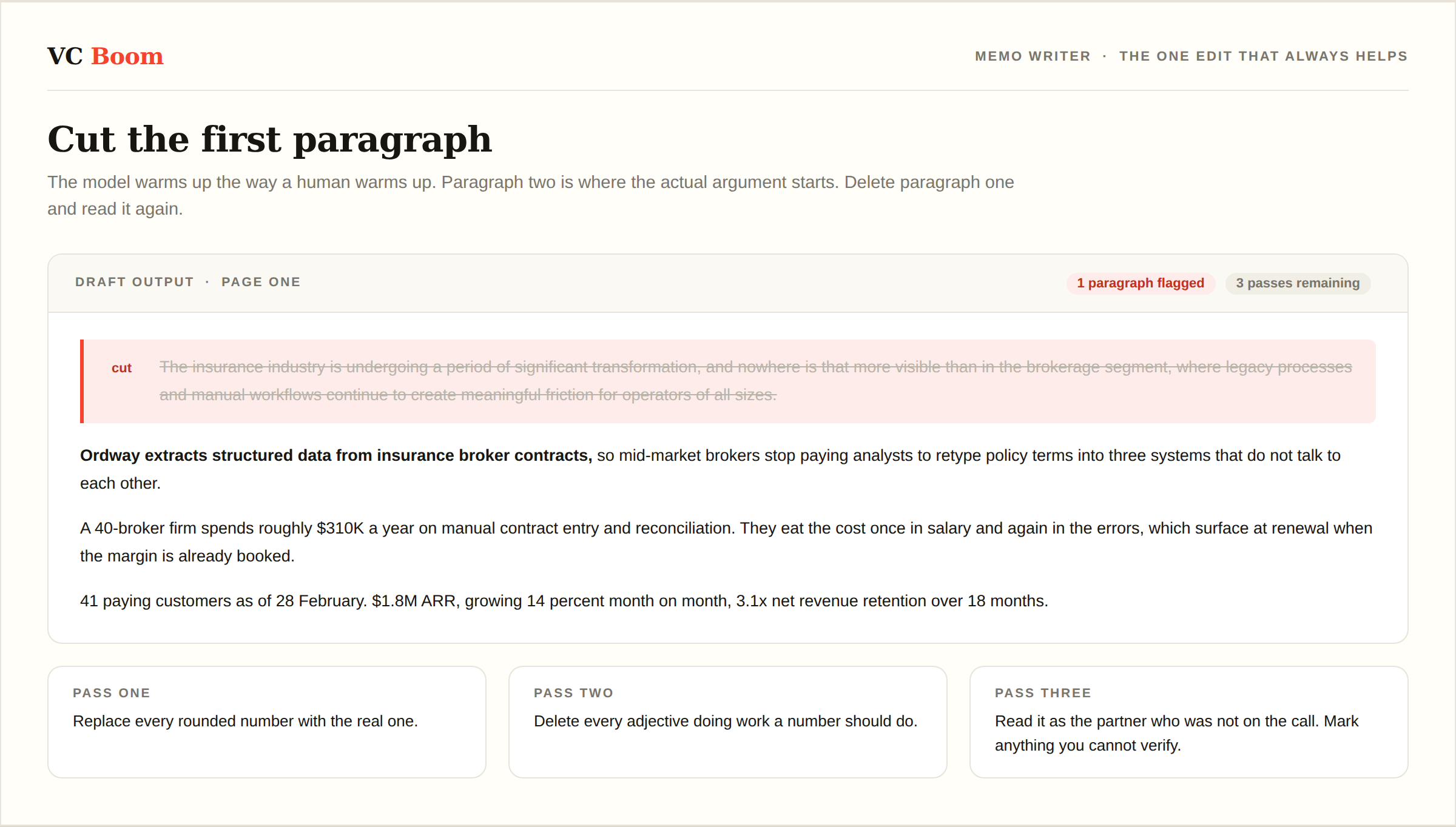
The first paragraph is almost always the one to cut. It is where the model warms up, and a partner reading on a phone will not wait for it.
The bar
You will know it worked when a partner forwards it with no commentary added. No "here is what I think," no three lines of framing. Just the memo.
That is the target. Zero commentary.
Founders on VC Boom have raised $133M+ across 1,264 companies working against 47,000+ investors in our data, and the pattern under most of those closes is the same. The deck opened the door. The memo walked through it.
Once the money is in, the same muscle keeps working. Your monthly investor update template is the memo, repeated, forever.
If you have a warm reply sitting in your inbox right now and your instinct is to resend the deck, stop and open Memo Writer at vcboom.com instead. Draft the two pages, cut the first paragraph, and send the thing your partner can actually forward. The Monday meeting is closer than you think.