How to Run Your First Deck Score and Fix the Right Two Slides
A founder sent me her deck last March after 41 investor emails and 3 replies. She was convinced the problem was her intro list. We scored the deck and traction came back at 34 while everything else sat comfortably in the 70s. She had been buying more envelopes for a letter nobody wanted to open.
Deck Score is not a design review. It is a diagnostic that tells you which slide is costing you the meeting.
What actually happens when you upload
You go to vcboom.com/upload and drop in a PDF. No signup. Free. It takes about 30 seconds on a light deck and up to 90 seconds on a heavy one with big embedded images.
Before you hit run, set the round. Pre-seed, Seed, Series A, Series B, or Auto-detect.
This matters more than founders expect. A Seed traction bar applied to a Pre-seed deck will punish you for not having revenue you were never supposed to have. If you know your round, name it. Auto-detect is for when your raise sits awkwardly between two labels and you genuinely want the system to place you.
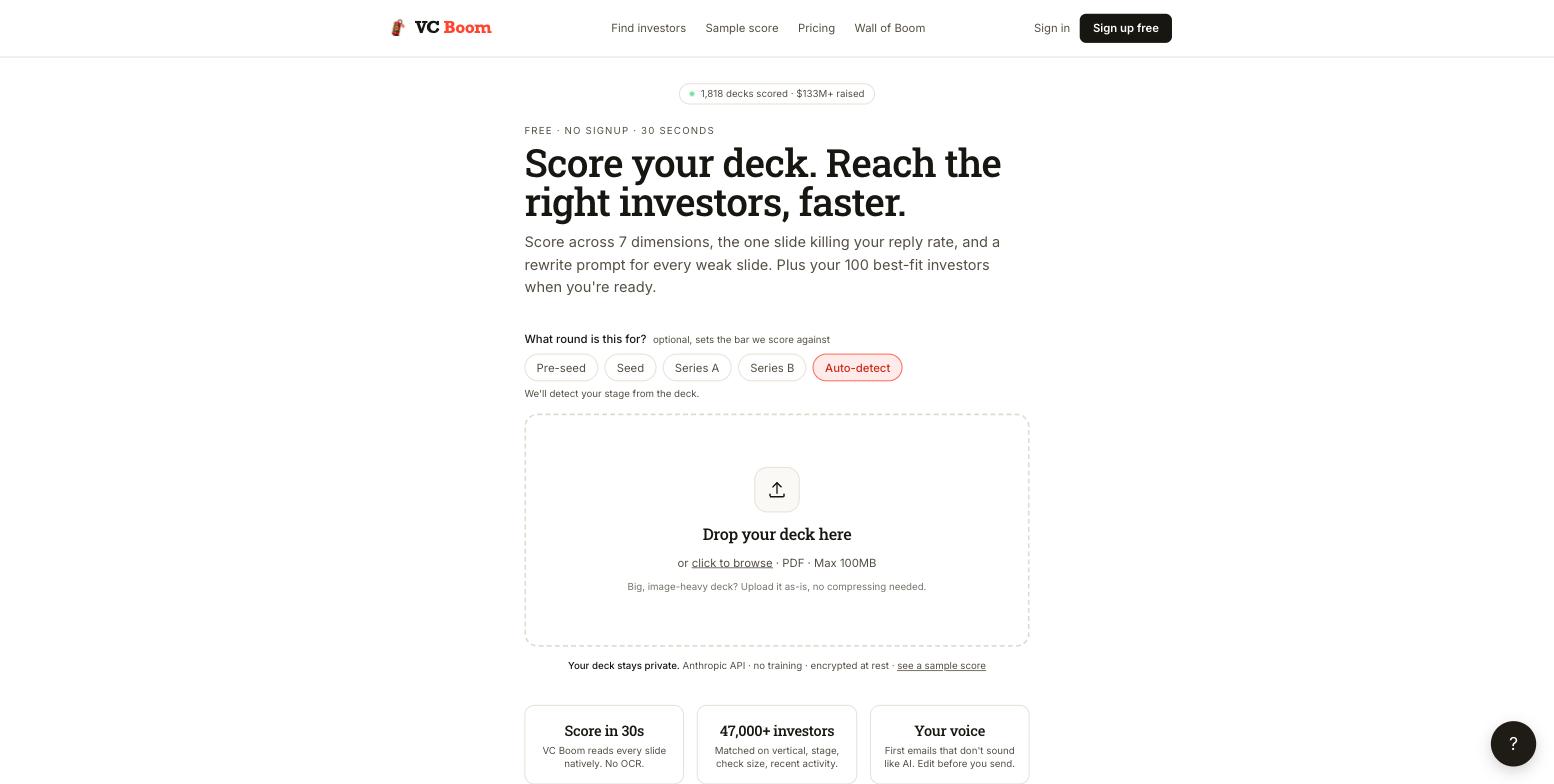
The upload screen at vcboom.com/upload. Pick the round or leave it on auto-detect, drop the PDF, and the score comes back in about thirty seconds. No signup, no card.
Your deck stays private. It is processed via the Anthropic API, never used for training, and encrypted at rest. We have scored 1,820 decks and none of them went anywhere.
If you want to see the output shape before you upload anything of your own, there is a public sample at vcboom.com/sample-score.
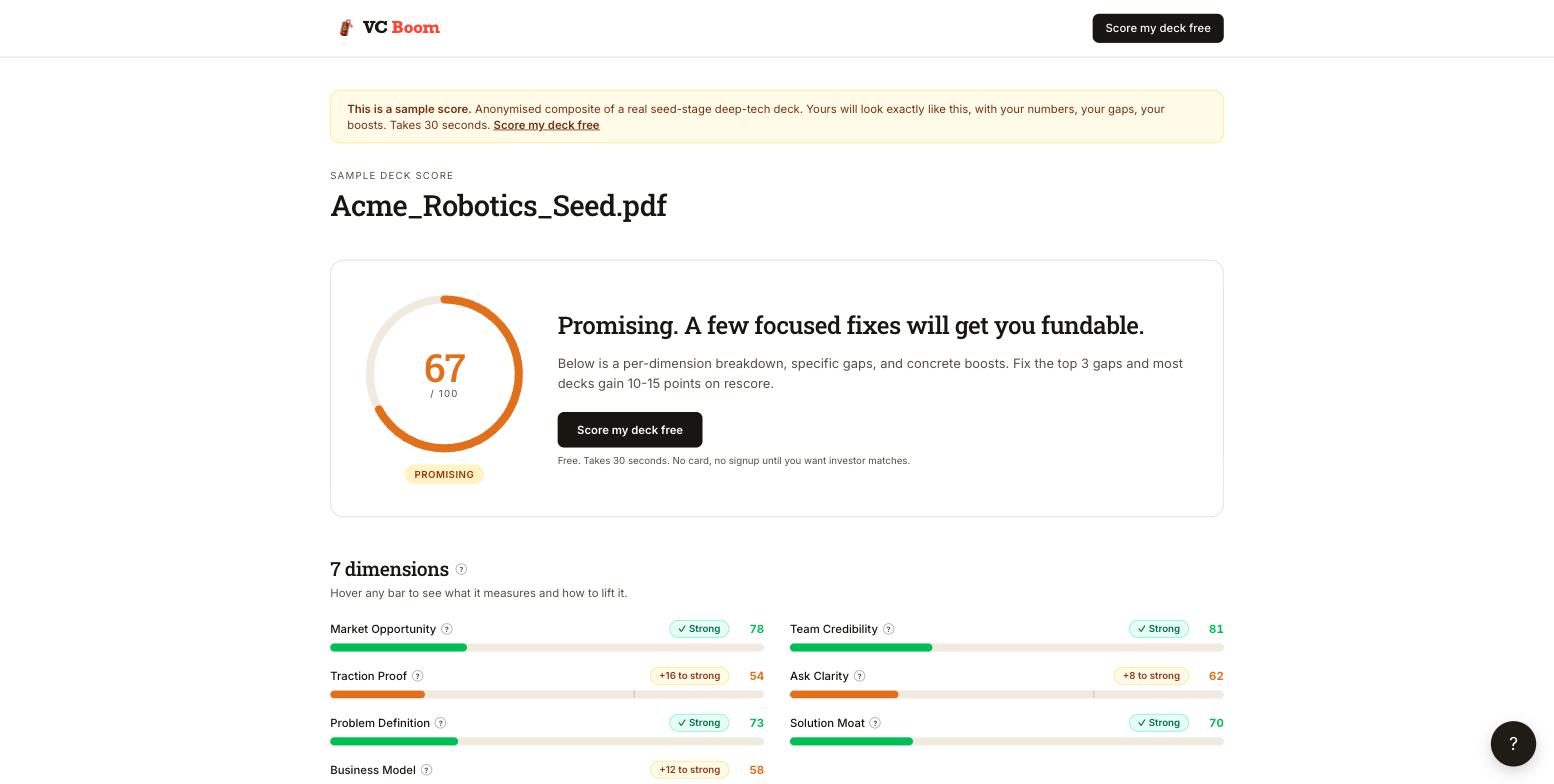
The public sample. A 67 comes back as "promising", which is the polite way of saying two things are wrong and both are fixable. This is the whole report, on a real deck, without giving anyone your own.
The seven dimensions, and what each one is really asking
You get a score on market opportunity, team credibility, traction proof, ask clarity, problem definition, solution moat, and business model.
Every dimension is a proxy for a question an investor asks silently in the first ninety seconds of reading.
Market is not "is this big". It is "do you understand the shape of the wedge you enter through". Most founders lose points here by pasting a top-down number, which is the exact failure we broke down in the TAM slide mistake piece.
Team is not credentials. It is founder-market fit made legible.
Traction is the one that punishes vagueness hardest. "Growing fast" scores badly. Two dated numbers score well.
Ask is whether the amount, the runway, and the milestone form a single sentence that makes sense together.
Problem is whether the pain is specific and owned by someone with a budget. This is where decks die quietly, usually around slide three, which we covered in the page 3 problem breakdown.
Moat is what stops the obvious competitor from doing this next quarter.
Business model is whether the way you make money is stated plainly enough that a partner can hold it in their head. Unit of demand, price, who pays. The full scoring logic behind all seven sits in the criteria VCs actually use.
Reading the result without lying to yourself
The output gives you three things.
The score per dimension. The one slide killing your reply rate. And a rewrite prompt for every weak slide.
Founders read this wrong in a predictable way. They scroll to the highest number, feel good, then start editing the slide they enjoy editing most. Usually that is the product slide, and usually the product slide was already fine.
The number that matters is your lowest one. Not your average. Investors do not average you. They find the weakest claim and stop.
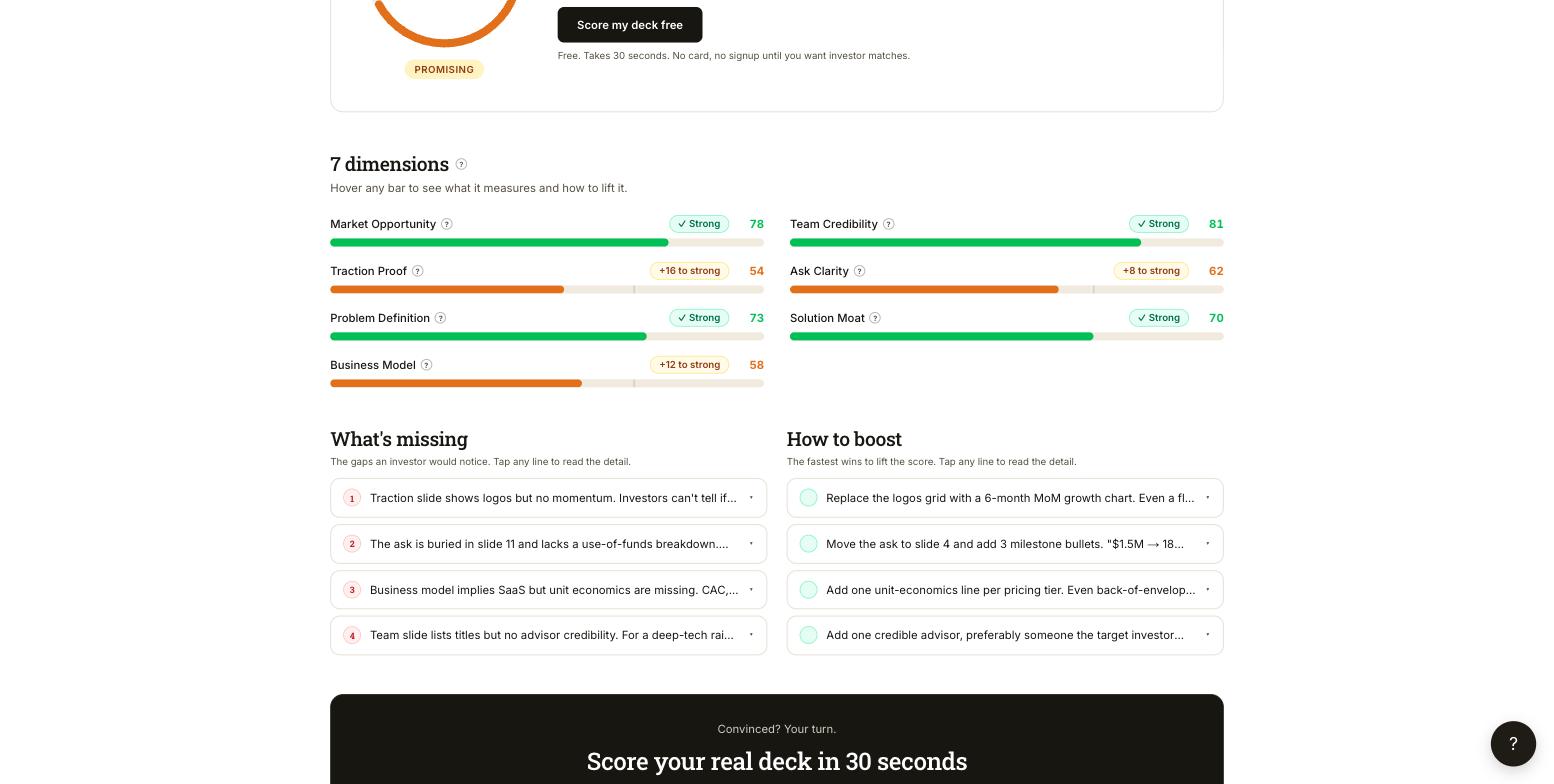
A real result. Seven dimensions, each with a score and a named gap. Traction Proof at 54 and Business Model at 58 are where this deck loses the room, and the panel on the right tells you exactly what would move them.
The "one slide killing your reply rate" callout is the single most useful line in the report. It is not always the lowest-scoring dimension. Sometimes moat scores 41 but the flagged slide is your ask, because a broken ask blocks the meeting even when the rest of the argument works. We pulled apart which dimension moves outcomes most in a follow-up breakdown.
Fix two. Only two.
Here is the method, and it is the whole point of the product.
Fix only the lowest two dimensions. Re-score. Do not touch anything already working.
The instinct is to rebuild the deck. Do not rebuild the deck. When you rewrite eight slides at once you break the things that were scoring 78 and you have no idea which change moved the number. You have destroyed your own signal.
Two changes. One re-score. Read the delta.
Each weak slide comes with a rewrite prompt. Paste it into Claude with your actual numbers and your actual customer language. The prompt is scoped to the specific failure the scorer found, so it will not hand you generic deck advice.
Then re-upload and run it again.
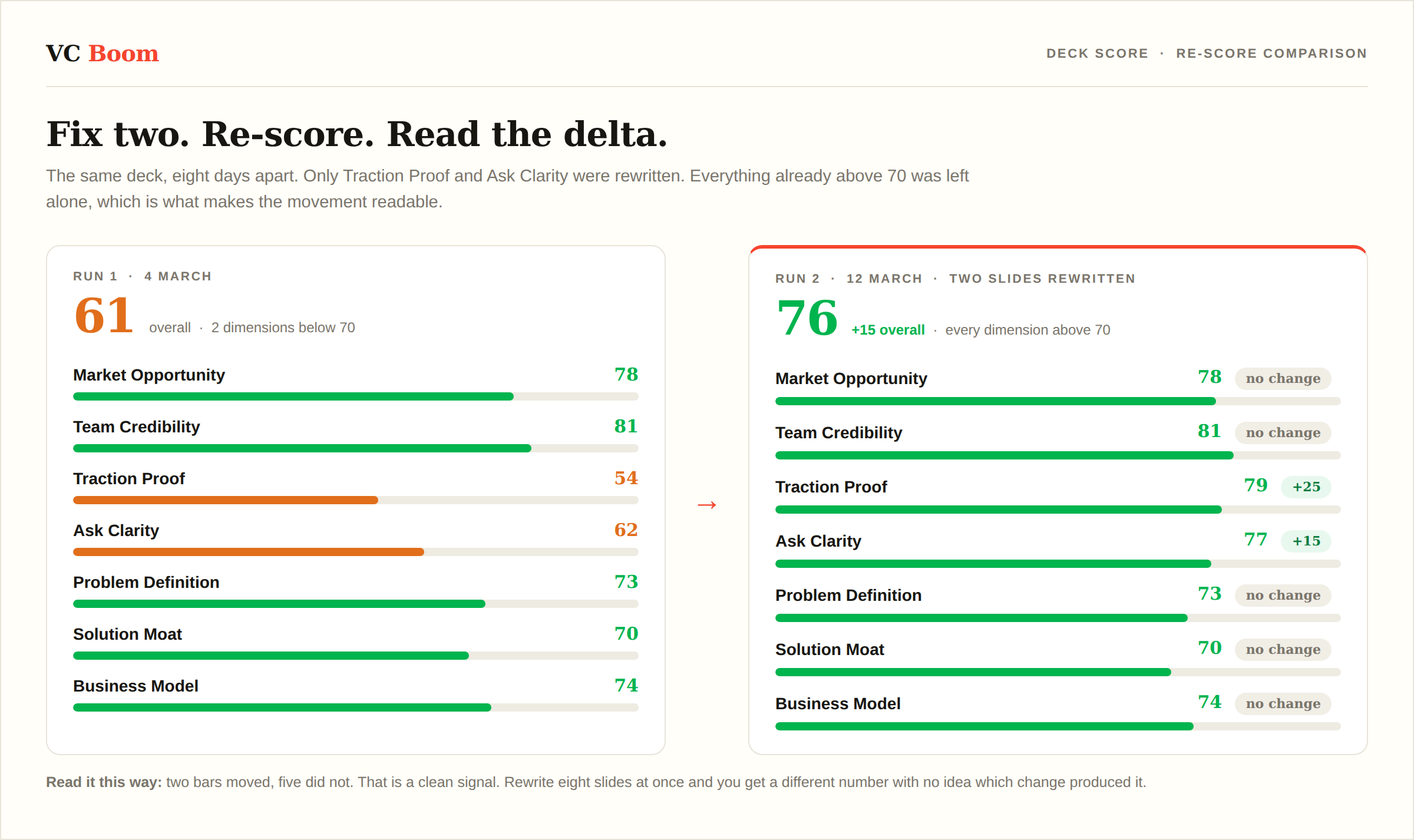
The same deck eight days apart. Two dimensions rewritten, five left alone, and the delta is readable because of what was not touched.
The number to aim at
Target every dimension above 70 before you send to a single investor.
Not your average above 70. Every one of them. A deck with six dimensions at 85 and one at 38 is a deck with a 38 problem.
Below 70 on any dimension, you are spending intro capital to teach an investor why they should not fund you. Those intros do not regenerate. The connection between score movement and actual reply behaviour is consistent across the decks we have scored.
Across 1,820 decks scored and $133M+ raised by founders who used this loop, the pattern holds. Founders who fix two and re-score beat founders who rebuild once.
What to do the same day you clear 70
Stop editing. Start routing.
A 70-plus deck sent to the wrong forty investors performs worse than a 62 deck sent to twelve people who fund your stage and sector. Once the deck holds, the constraint moves. It is not a writing problem anymore. It is a routing problem, and that is what the 47,000+ investor database exists to solve.
The sequence is fixed. Score, fix two, re-score, clear 70, then build the list.
Run your first score at vcboom.com and give yourself ninety seconds of honesty before you spend another week of intros. Set your round, read your lowest two numbers, and resist every urge to touch the slides that are already working.