Build Your Data Room In Week One, Not Week Six
A partner emails on a Thursday afternoon. Good meeting, want to move, send over the data room. The founder writes back "give me a few days to pull it together" and spends the weekend chasing a cap table from a lawyer who is on holiday. By the time the folder goes out on Wednesday, the partner has taken two other first meetings.
Nothing went wrong in diligence. Diligence just never started.
The delay is the finding
Diligence delay kills more rounds than diligence findings.
Investors rarely walk because of what they read. They walk because the gap between asking and receiving gave them time to cool off, and because a slow room reads as a slow company.
The moment you say "give me a few days", momentum transfers to them. You were running the process. Now you are asking for an extension.
The target is simple. You can share a link within 60 seconds of being asked, from your phone, in the taxi, without opening a laptop.
That is not an organisational flourish. It is a signalling decision.
What goes in it is already solved
We wrote the contents question up separately, so this guide does not repeat it.
The short version from our seed data room contents guide: the room is a signal, not a vault. 18 documents in four groups, plus two gap-closers. Most seed investors spend under an hour inside it.
That guide also lists the 6 documents that actively scare investors off. The 40-tab model. The NDA as a gate. Patents you have not filed. Press clippings. A bought market report. Anything half-finished.
Read it once, then come back here. This article is about the process, not the packing list.
Week one, before you have a reason
Build the room in week one of the raise, not when the first term sheet arrives.
The instinct is to wait. You do not want to spend three days on folders when you have not booked a single meeting. Fair. But that logic collapses the first time a warm intro converts faster than you expected.
Week one is also when you have the most slack. Your calendar is empty of investor calls. Your team is not answering questions from three funds at once. The work costs you less now than it will at any other point.
And building early surfaces problems while they are still fixable. A messy option pool takes two weeks and a lawyer. Discovering it in week six means you fix it under a live term sheet, which is the worst possible negotiating position. Our guide on cap table cleanup before a raise covers what usually breaks.
How Curator builds the structure
Open Data Room Curator, point it at your deck, your existing files and your company details. It does three things.
It builds the room structure, so you are filling in a shape rather than inventing one.
It tells you which documents are missing, by name, against what investors at your stage and sector expect to see.
It flags the ones that will generate questions. Not missing, present, and likely to trigger a follow-up you would rather answer on your own terms.
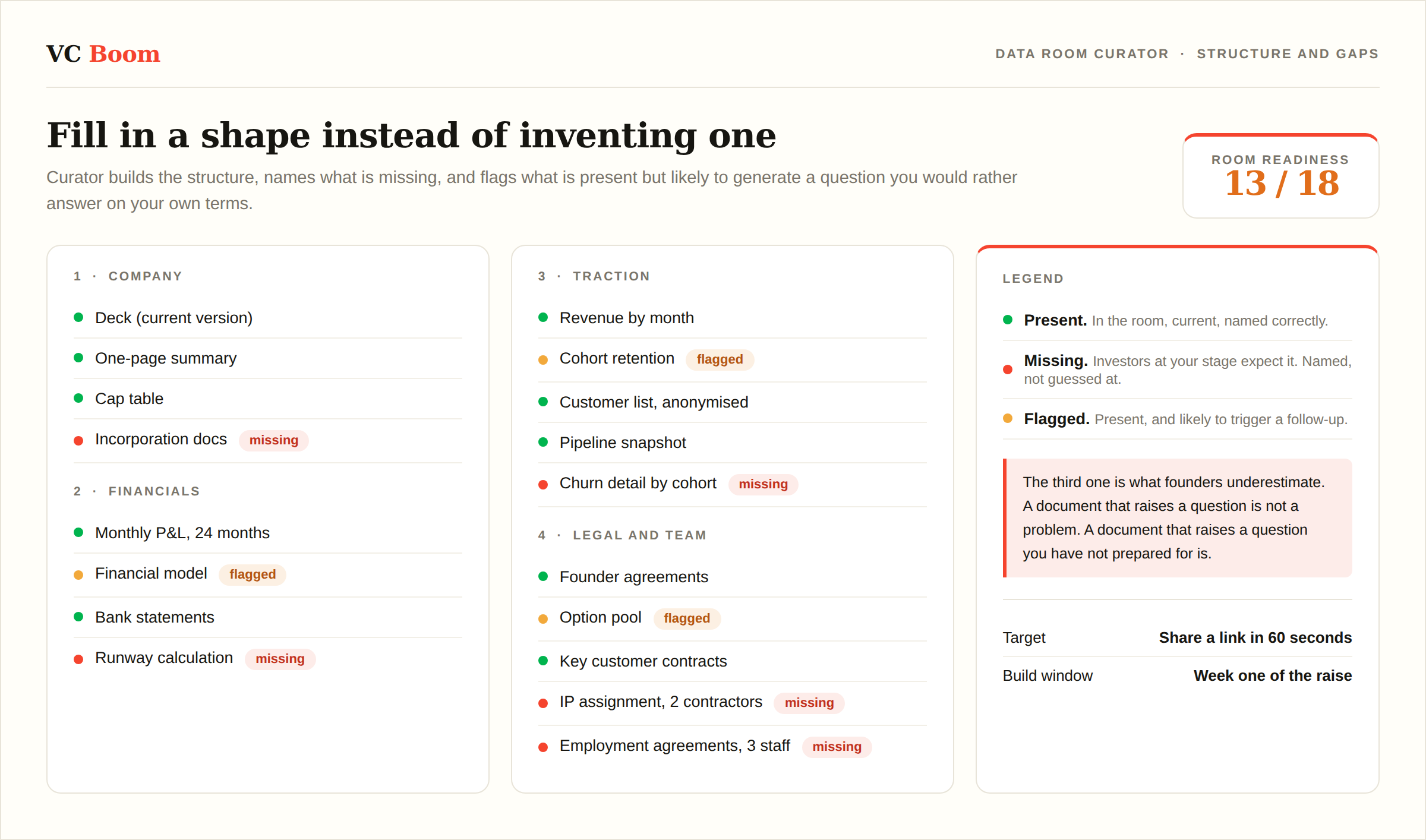
The generated structure, with every document marked present, missing or flagged. Thirteen of eighteen on day one is a normal starting point.
The third one is the part founders underestimate. A document that raises a question is not a problem. A document that raises a question you have not prepared for is.
Pressure-test before you send
Once the room is populated, run it against the questions it will actually receive.
Curator reads your room the way an associate does, then produces the questions each document invites. Revenue defined three ways across two files. A churn number in the deck that does not reconcile with the cohort tab. A founder vesting schedule that restarts next quarter.
You will recognise most of these from our list of VC due diligence questions. The difference is that Curator points them at your specific files rather than at the general case.
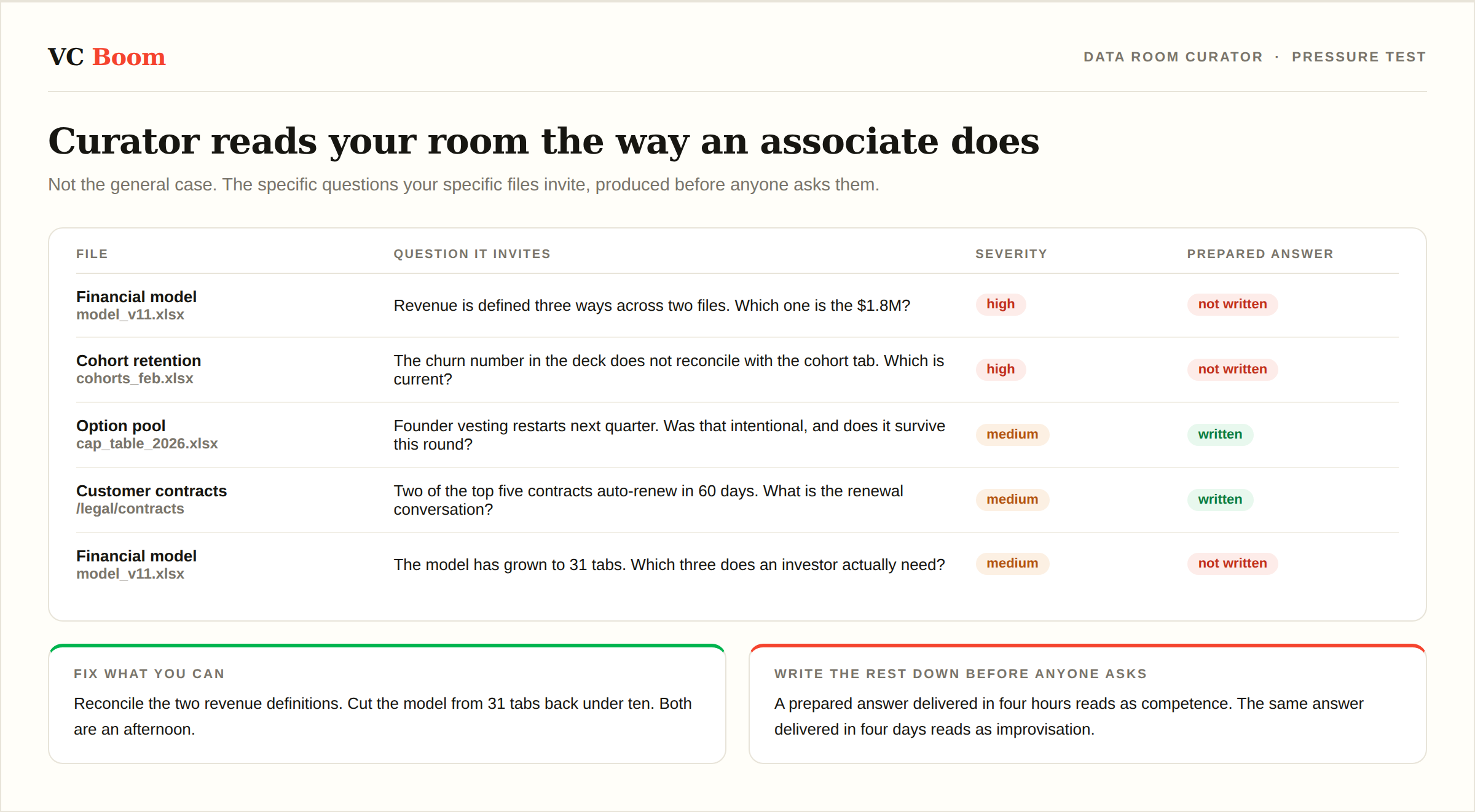
The pressure test. Not the general due diligence list, the specific questions your specific files invite, with a column for whether you have written the answer down yet.
Fix what you can. For the rest, write the answer down before anyone asks it. A prepared answer delivered in four hours reads as competence. The same answer delivered in four days reads as improvisation.
Then check the room against the negative list. Founders keep adding, and the additions are usually the six things that hurt. If your model has grown past ten tabs during the build, cut it back.
Keeping it current during a live raise
The room is not a deliverable. It is a live surface for the length of the process, and stale rooms leak credibility fast.
Three habits.
Update the metrics file on a fixed day each month, whether or not anyone has asked. A room with last month's numbers in it on the 20th tells an investor how you run everything else.
Re-run Curator after any structural change. New note, new hire in the leadership team, a customer contract that changes concentration. The room drifts out of date fastest in exactly the weeks it is being read.
Log what each investor has actually seen. When five funds are in at different depths, you need to know who has the updated model and who has the one from three weeks ago. That matters when a process turns competitive, and the timing patterns in our seed round timeline data show how compressed that window usually is.
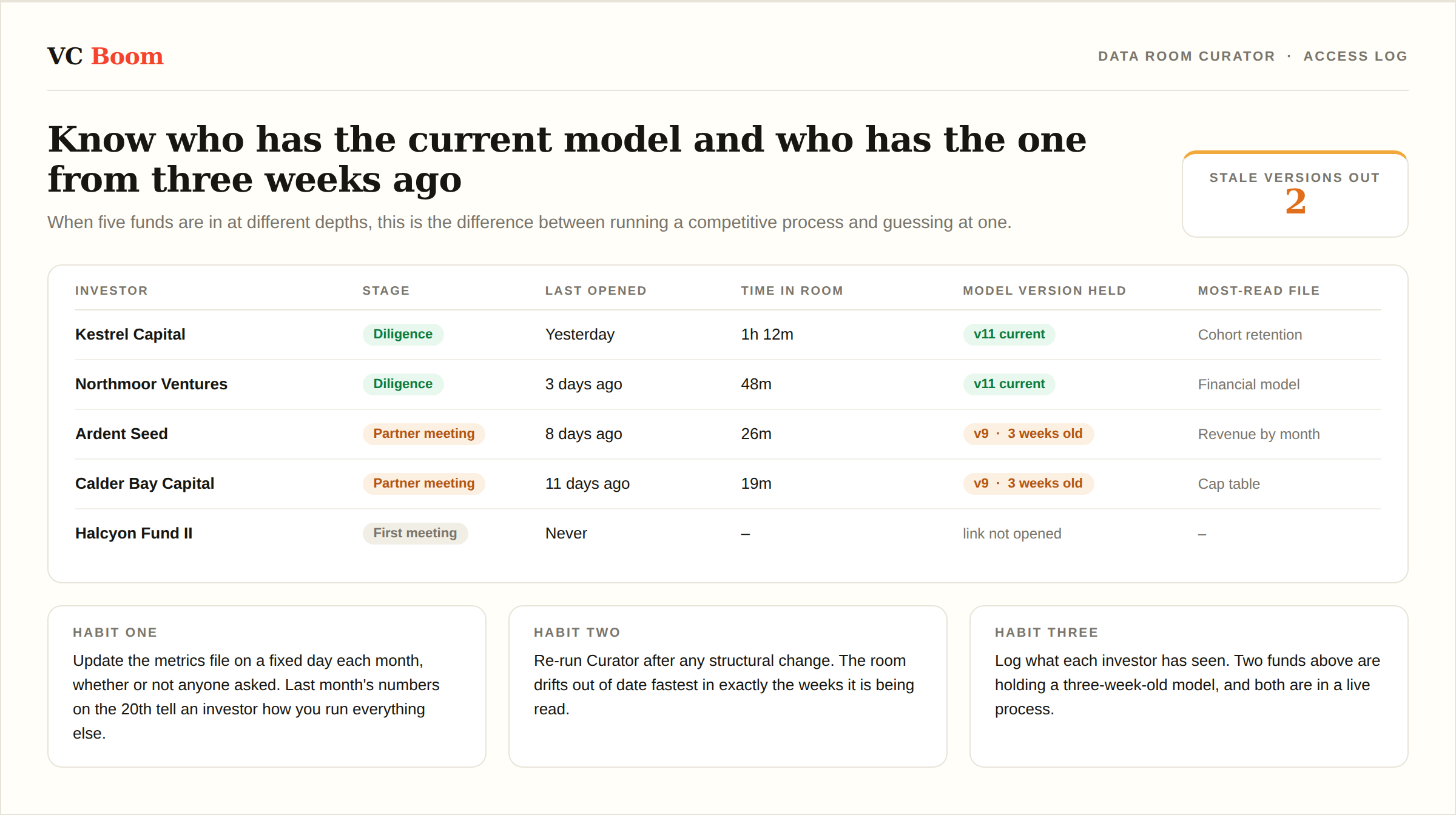
Who has seen what, and which version they are holding. Two funds on a stale model is the kind of thing you find out at the worst possible moment if you are not logging it.
One more thing. The instrument you are raising on changes what the room needs. A priced round pulls in more legal and governance material than a SAFE does, which is worth deciding early rather than mid-process. Our comparison of SAFE versus priced rounds sets out the difference.
What this actually buys you
Not a better outcome in diligence. A faster start to it.
The founder who answers on Thursday afternoon is in diligence while the other one is still emailing a lawyer. Same company quality. Different position in the process.
Speed here is cheap. It costs you two days in week one and it buys you the ability to say yes instantly, every time, for the whole raise.
We have scored 1,820 decks, worked with 1,264 founders and helped them raise $148M+, and the pattern is consistent. The rooms that were ready before anyone asked belonged to the rounds that closed on schedule. Run your files through the Data Room Curator on vcboom.com this week, find the gaps before an investor does, and get the link ready while your calendar is still quiet.